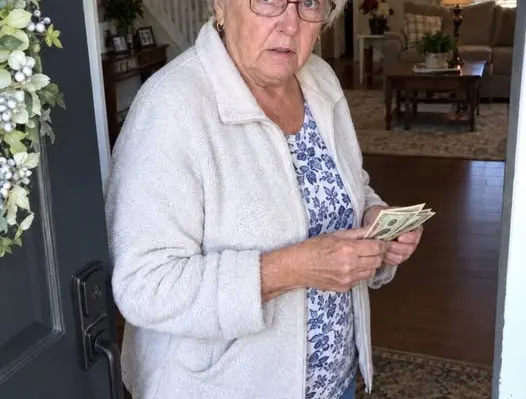
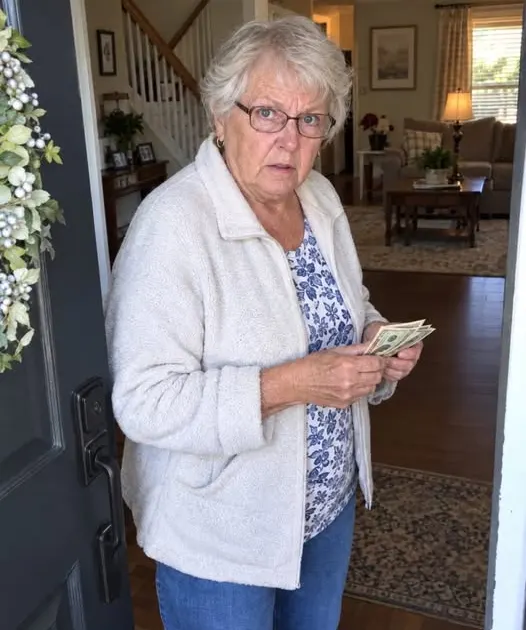
My Mom Charged Me 40 To Babysit Until I Learned What The Money Was Really For
“I can’t.”
I stared at my phone like my mother could somehow feel me staring through it.
“What do you mean, you can’t?”
There was a pause on the line, one of those pauses that tells you the person on the other end is choosing their words carefully, which my mother almost never did.
Then she said, “I can’t stop charging you.”
Also readMy Husband’s Aunt Knew What His Parents Hid About the FarmhouseI actually laughed. Not because it was funny. Because I had spent the last two months trying and failing to understand why my sixty six year old mother had suddenly, inexplicably, turned babysitting her own grandson into a cash only business, and now here she was confirming that yes, this was really happening, and no, she was not going to explain it.
“Mom, that makes no sense,” I said. “None. Do you hear yourself?”
“I know.”
“No, seriously. You used to get offended if we so much as mentioned hiring someone else.”
“I remember.”
“You used to answer the phone and before I could even ask, you’d say, bring me my grandson.”
“I remember saying that too,” she said quietly.
“And now it’s forty dollars. Cash. Every single time he walks through your front door.”
Another pause. Longer this time.
Then she said, so softly I almost missed it, “I need you to trust me a little longer, Nora.”
That did not help. That helped nothing at all.
“Trust you with what, Mom? You’re not giving me anything to trust. You’re just taking my money and telling me to trust you.”
She sighed, and I could picture exactly what she looked like doing it, standing in her kitchen with her free hand pressed to her forehead. “I can’t explain it yet. I just, I can’t. Not yet.”
And I felt all my irritation come rushing back in a hot wave.
“Then don’t be surprised,” I said, “when we stop asking you to babysit.”
Her voice changed immediately, all the careful calm draining out of it. “Please don’t do that. Nora. Please don’t do that.”
“Then tell me what’s going on.”
“I can’t.”
And there it was, that word again. Not I won’t. She never once said I won’t. She said I can’t. And it took me two months and a metal cash box on a kitchen table to understand the difference.
Let me back up and explain why this had become such an enormous deal, because on its face, a grandmother asking for a little money to babysit isn’t a scandal. Grandparents don’t owe anyone free childcare. I know that. I’ve always known that.
My mother, Diane, had been watching my son Caleb since he was a newborn. Not every day, nothing so formal as that. Usually it was when my husband Ryan and I got stuck late at work, or when we had appointments we couldn’t bring a seven year old to, or on the rare, precious occasions when we wanted to go out to a dinner where nobody asked us to cut their chicken into smaller pieces.
And my mother always volunteered. Actually, volunteered is far too mild a word for it. She practically demanded access to her grandson. If I ever so much as mentioned the idea of hiring a sitter, she would be genuinely wounded.
“What am I,” she’d say, “a stranger? Some woman off the street?”
Or, “Why on earth would you pay somebody when I live fifteen minutes away and would give my right arm to have him?”
Caleb is seven now. And my mother’s whole house is built around him, has been for years. She keeps dinosaur shaped chicken nuggets in her freezer at all times because they are his favorite and heaven forbid he should ever arrive and want them and not find them. There is still a little plastic step stool beside her bathroom sink so he can reach to wash his hands, even though he’s tall enough now that he barely needs it. His drawings, years of them, cover one entire side of her refrigerator, layered over each other, the older ones going soft and yellow at the edges. She keeps a drawer in her spare dresser full of pajamas for him, in ascending sizes as he’s grown.
This is a woman who wove her grandson into the fabric of her home. So when she first told me, out of absolutely nowhere, that she wanted forty dollars to watch him, I genuinely thought she was making some kind of joke I didn’t understand.
It had started about two months earlier. Ryan had to work late on a Thursday, and I had a parent teacher meeting at Caleb’s school that I couldn’t miss and couldn’t bring him to.
I called Mom. “Hey, can Caleb come stay with you after school today? I’ve got that meeting, and Ryan’s stuck at work. I can pick him up around eight thirty.”
“Sure,” she said. Easy, warm, the way she always said it.
And then, so casually I almost didn’t register it, she added, “Just bring forty dollars when you come.”
I laughed. She didn’t.
“Wait,” I said. “Seriously?”
“Seriously.”
I remember actually sitting up straighter in my chair, like my posture might help me understand what was happening. “Why? Mom, why would you charge me to watch Caleb?”
“I’m not charging much,” she said, which was not an answer to the question I’d asked.
“That’s not what I asked you.”
And then her tone changed, went a little clipped and defensive. “If you don’t want to pay, Nora, you’re welcome to find somebody else.”
That stung more than I expected it to. And again, not because I felt entitled to free babysitting. It wasn’t about the principle of grandparents and money. It was the suddenness of it. It was the whiplash. This was a woman who had watched Caleb hundreds of times over seven years without ever taking a single dime. Who had bought diapers and formula when he was tiny and money was tight for Ryan and me. Who had taken him to the zoo, to the aquarium, to the children’s museum, footing the bill every time and waving me off when I tried to pay her back. Who had once, memorably, driven all the way across town at nine o’clock at night because Caleb had left his stuffed dinosaur, the specific one, the irreplaceable one, at her house, and apparently sleep was simply not possible without it.
That was my mother. And now she wanted cash at the door before she’d take her own grandson inside.
But I needed the help that Thursday. So I paid her the forty dollars, and I told myself it was a fluke, some strange one time thing, maybe she was short on cash for something and too proud to say.
The next week, it happened again.
And then again.
Always forty dollars. Always exact. And here was the detail that started to really bother me: always cash. Not once did she say, oh, just Venmo it to me, or write me a check, or don’t worry about it this time and get me next time. It was cash, in hand, at the door, every single time, and the amount never changed no matter how long she had him. Sometimes she watched Caleb for four hours. Sometimes for ninety minutes. Same forty dollars either way. A flat rate, cash only, no exceptions.
After the fifth time, Ryan looked at me across the kitchen one night after we’d put Caleb to bed and said, “Do you think she’s having money problems? Your mom?”
“I honestly don’t know,” I said. And I didn’t.
Because here’s the thing. It didn’t fit. Her house had been paid off for years. She got her Social Security, and a small pension from the school district, where she’d worked as a school secretary for almost thirty years before she retired. She wasn’t wealthy, not by any stretch. But she was careful, careful in the way of a woman who’d raised two kids on a secretary’s salary and knew the value of every dollar. This was a woman who rinsed out and reused Ziploc bags, who would hold a used sandwich bag up to the light and declare, with total conviction, “Nothing happened to this. It’s fine.” Who saved rubber bands and twist ties and the little packets of soy sauce from takeout.
A woman like that suddenly collecting forty dollar fees from her own daughter to see her own grandson simply did not compute. It was like a puzzle piece from a completely different puzzle.
Then came the wedding.
Ryan and I had a wedding to attend, an old friend of his, one of those all afternoon and evening affairs. Mom had Caleb from late afternoon until around ten thirty at night, the longest stretch yet. When we came to pick him up, he was fast asleep on her couch, tucked under the same faded blue blanket I’d slept under as a child, the one that had gone from my bed to a storage box to my mother’s couch over thirty years. Ryan grabbed his backpack and I gathered Caleb up into my arms, his head heavy and warm against my shoulder, and I turned to leave.
And my mother said, quietly, “You forgot.”
I knew exactly what she meant. The forty dollars.
I shifted Caleb’s weight and dug my wallet out one handed. But all I had in it was a twenty and a hundred dollar bill. “I’ve only got a hundred and a twenty,” I said. “I’ll bring you the rest tomorrow, I promise.”
My mother shook her head. “I need the forty dollars tonight.”
That irritated me instantly, the flatness of it, the insistence, at ten thirty at night with a sleeping child in my arms.
“Mom,” I said. “Seriously? Right now? I’ll bring it tomorrow.”
She glanced toward the living room, toward Caleb sleeping on the couch, and there was something in her face I couldn’t read. “Yes,” she said. “Seriously. Tonight.”
So I handed her the hundred. And she disappeared into her bedroom for a minute and came back with sixty dollars in exact change, counted out into my palm, so that I’d paid precisely forty and not a penny more or less.
On the drive home, with Caleb finally buckled into his booster seat and dead asleep, I told Ryan I was done.
“I’d honestly rather just pay an actual sitter at this point,” I said. “A teenager from down the street. At least a normal babysitter I understand. At least there are rules. At least it makes sense.”
Ryan nodded, watching the road. “At least then we’d know what the arrangement is,” he agreed. “This whole thing with your mom is starting to feel like something else. I don’t know what, but something.”
So for the next three weeks, we didn’t ask my mother to watch Caleb. Not once.
And of course she noticed. Of course she did. This was a woman who called to check whether I was drinking enough water. Three weeks without her grandson was not something that was going to slip past her.
She called twice, both times circling around it, asking why she hadn’t seen Caleb, whether everything was okay, whether he’d liked the new dinosaur book she’d found. I told her we’d just been busy. Which was a lie, and she knew it was a lie, and she let me tell it anyway, which was its own kind of sad.
And then came the phone call that changed everything. She called on a Tuesday evening, and after a minute of small talk, she just asked me directly.
“Are you upset about the money, Nora?”
And something in me, tired of the whole thing, just answered honestly. “What do you think, Mom?”
“Please don’t stop bringing him here because of it,” she said. “Please. I miss him. Please don’t keep him from me over this.”
“Then stop charging us,” I said. “It’s that simple. Just stop, and we’ll be there tomorrow.”
“I can’t.”
“What does that mean?” I said, and I could feel my voice climbing. “What does that actually mean, Mom, I can’t? You’re the one charging. You can absolutely stop. Just decide to stop.”
And this time she went quiet for so long that I genuinely thought the call had dropped. I said, “Mom? Hello?”
And then she said, in a different voice, smaller and more serious than I’d heard from her in a long time, “Come over tomorrow. After work. Alone.”
My stomach tightened. “Why alone? Why can’t Ryan come?”
“Because I need to show you something. And I want to show you, not tell you. Just you, first.”
“Mom, are you in some kind of trouble?”
“No.”
“Are you sick? Is that what this is? Are you sick and you don’t want to scare Caleb, so you’re using the money to—”
“No,” she said. “I’m not sick, honey. I promise.”
“Is somebody taking money from you? A scam, one of those phone scams, someone pretending to be from the bank—”
“No. Nobody’s taking anything from me. Nora, I promise you, nobody’s hurting me and I’m not sick and I’m not in trouble.”
“Then what? What could it possibly be?”
“Tomorrow,” she said. “I’ll show you tomorrow.”
I barely slept that night.
By the time I’d lain in bed running through it, my mind had built a dozen different catastrophes. Debt. Some predatory loan she’d fallen into. A gambling problem she’d been hiding, some online thing that had gotten out of hand. Someone blackmailing her. A secret, terrifying medical bill she was too proud and too scared to tell me about, and the babysitting money was the only way she knew how to chip away at it. I lay there in the dark and imagined my careful, Ziploc rinsing mother slowly drowning in something she couldn’t say out loud, and by morning I was a wreck.
Ryan noticed, of course. When I finally gave up on sleep around five and went down to the kitchen, he followed me and asked what was wrong, and I told him about the phone call, about come over alone, about I want to show you something. He frowned into his coffee.
“You want me to come with you anyway?” he offered. “I can move some things around.”
“She said alone,” I said. “Specifically alone. Whatever it is, she wants it to be just me.”
“That’s either a very good sign or a very bad one,” he said, which was exactly what I’d been thinking and exactly what I did not want to hear out loud.
I spent the whole workday useless, staring at my screen, replaying my mother’s voice saying I can’t over and over. By the time I got to her house that evening after work, I’d braced myself for the worst.
She opened the front door before I’d even knocked, like she’d been standing right behind it waiting.
“Come in,” she said.
And she looked completely normal. That almost made it worse, somehow. She looked exactly like my mother, in her cardigan and her reading glasses pushed up on her head, and I couldn’t square that ordinary face with all the disasters I’d spent the night imagining.
On the kitchen table sat a metal cash box. The gray kind with a little lock, the kind you’d buy at an office supply store. I stopped in the doorway and stared at it.
“What is that?” I said.
“Sit down, honey.”
“Mom.”
“Please. Just sit.”
I sat.
And she reached over and opened the box.
Inside were envelopes. A lot of them. Dozens, it looked like, standing in neat rows. And each one had a date written across the front in my mother’s careful, looping handwriting. And across the top of every single envelope, printed in black marker, was one word.
CALEB.
I looked up at her. “Mom. What is this? What am I looking at?”
She reached in and took out the first envelope, the one at the front. She opened it and tipped it slightly so I could see inside.
Forty dollars.
She set it down and took out the next one. Opened it. Forty dollars.
And I understood, slowly, what I was seeing. Every single payment Ryan and I had given her over the past two months. Every forty dollars I’d handed over at her door, irritated, resentful, thinking she was nickel and diming us for the privilege of seeing her grandson. All of it. She hadn’t spent a cent of it. It was all still here, sorted into dated envelopes with Caleb’s name on them.
“You kept all of it,” I said. “You didn’t spend any of it.”
“Yes,” she said.
“Why? Mom, why would you make me pay you and then just, keep it in a box?”
She pushed a small spiral notebook across the table toward me. “Open it.”
I opened it. And inside, in the same careful handwriting, were columns. Dates. Amounts. Little notes beside each entry, describing what the babysitting had been for.
Thursday, school meeting, forty dollars.
Saturday, the wedding, forty dollars.
Down and down the page, every single time she’d watched Caleb, logged and dated and annotated.
And then, at the bottom of the most recent page, there was a running total. And I stared at it, and something didn’t add up, because the number at the bottom was significantly larger than the sum of everything Ryan and I had ever paid her.
“Wait,” I said. “This total. This is more than we gave you. This is way more than forty dollars times the number of times you watched him. Where did the extra money come from?”
My mother folded her hands on the table.
“Because I’ve been adding to it,” she said. “My own money. On top of what you paid.”
And just like that, all of my irritation was gone. Whatever I’d walked in prepared to be angry about, this wasn’t it. This was something else entirely, and I didn’t understand it yet, but I could feel that it was going to change something.
“Mom,” I said slowly. “What is this? What is all of this for?”
She looked down at the box, at all those envelopes with my son’s name on them.
“For Caleb,” she said.
I almost laughed, despite everything. “Well, obviously. His name is on every single envelope. But that’s not, that doesn’t explain—”
“No,” she said, and her voice went soft. “Not for now. For later.”
And I still didn’t understand. I sat there in her kitchen looking at a metal box full of my own money plus more of hers, all labeled with my son’s name, and I could not make the pieces fit into any shape I recognized.
Then she reached back into the cash box, underneath the envelopes, and pulled out a folded brochure. She smoothed it flat on the table and turned it toward me.
It was from a pediatric hospital. A foundation, some kind of family assistance fund attached to the children’s hospital across town. There was a photograph on the front of a child in a hospital bed, smiling, and a warm banner of text I couldn’t read from where I sat.
I looked at the brochure, and then up at my mother.
“Mom. What is this? What does a children’s hospital have to do with you charging me to babysit?”
She swallowed. And when she spoke, her voice had changed again, gone careful and quiet, and I could tell we’d reached the real thing, the center of it.
“Do you remember,” she said, “when Caleb was three, and he had that heart murmur?”
And my chest went tight, instantly, all on its own, the way your body remembers a fear even years later.
Of course I remembered. At one of his regular checkups, his pediatrician had put the stethoscope to his little chest, and paused, and listened for a beat too long, and then said, in that carefully neutral doctor voice, that she was hearing something. A murmur. Probably nothing, she said, most of these are nothing, but she wanted us to see a pediatric cardiologist just to be safe.
Probably nothing. The two worst words in the English language when they’re about your child’s heart.
We spent almost two weeks living in that word probably. Two weeks of me googling things I shouldn’t have googled at two in the morning. Two weeks of watching my three year old run around the living room, perfectly happy, and feeling my own heart seize up every time he got out of breath. I remember lying awake counting his breaths, remember Ryan and me not talking about it because both of us were afraid that saying the worst out loud might somehow make it real. And then, finally, the appointment, and the echocardiogram, and the pediatric cardiologist looking at the images and then looking at us and saying the words that let me breathe again. An innocent murmur. Very common. Completely benign. Nothing dangerous, nothing that would ever require treatment, something he’d very likely outgrow entirely.
I remembered sitting in my car in the hospital parking garage afterward and crying so hard I couldn’t drive for twenty minutes. Not sad crying. The other kind. The kind that comes out of you when a terror you’ve been holding for two weeks suddenly has nowhere to go. I remember promising myself, in that garage, that I would never take a single ordinary healthy day with him for granted again. And I remember how completely I’d forgotten that promise within a month or two, the way you do, the way you almost have to, because no one can live at that pitch of gratitude forever. My mother, it turned out, had not forgotten. My mother had done something with it.
“Yes,” I said to my mother. “Of course I remember.”
She nodded slowly. “Do you remember the little boy in the waiting room? At the cardiologist’s office.”
I frowned. There had been a lot of children in that waiting room. It was a pediatric cardiology practice; the whole place was full of anxious parents and small kids. I didn’t—
And then, faintly, one surfaced. A little boy. Maybe five years old. Very thin, thinner than a healthy five year old should be, with the kind of pallor that even a child shouldn’t have. And he’d been wearing a red superhero cape, one of the little dress up ones, the fabric worn soft like he wore it everywhere.
“Sort of,” I said. “There was a boy in a cape. A little red cape.”
“His name was Noah,” my mother said.
I looked at her, startled. “How do you know his name? How could you possibly know that?”
She was quiet for a moment. And then I remembered.
My mother had come with us to one of those appointments. Ryan couldn’t get the time off work, and I had been too frightened to go alone and sit in that waiting room by myself with my three year old and my catastrophizing brain. So Mom had come. And while I was in the exam room with Caleb and the doctor, she’d stayed in the waiting room.
“His grandmother and I got to talking,” my mother said. “While you were back with the doctor. You know me. I can’t sit in a waiting room for forty five minutes and not talk to somebody.”
That was true. My mother could and did make friends everywhere. In pharmacy lines. In the produce section. At the DMV. It was one of the most maddening and most wonderful things about her.
“Noah had a congenital heart condition,” she went on. “A serious one. He’d already had two surgeries by the time he was five. His grandmother told me all about it while we sat there.”
My stomach had gone tight and low. “Okay,” I said.
“And she told me,” my mother said, “that they were drowning.”
“Financially, you mean?”
“Financially. But not only. Everything. Drowning in everything.” She rubbed her thumb slowly along the edge of the brochure. “Noah’s mother had cut her hours way back at her job, because someone had to be at every appointment, every surgery, every hospital stay, and there were so many of them. And his father had lost his job entirely somewhere in the middle of it all. They had insurance, but not the kind of insurance that covers what a sick child actually costs. The gas to get to the hospital forty minutes away, three, four times a week. The parking, which the grandmother said was outrageous, ten, fifteen dollars every single visit and it added up to hundreds. The hotel nights when Noah had to stay over and they lived too far to keep driving back and forth. The meals eaten out of vending machines. All the things, she said, that insurance doesn’t think of as medical, but that are the difference between a family holding together and a family coming apart.”
I still didn’t fully understand what any of this had to do with Caleb, or with the forty dollars in envelopes on the table between us. But I was listening now, all the way.
“That day scared me, Nora,” my mother said.
“I know it did, Mom. It scared all of us. The whole thing with the murmur—”
“No,” she said. “Not only because of Caleb. That’s what I’m trying to tell you.” She looked up at me, and her eyes were bright. “I sat in that waiting room, next to that woman whose grandson was so sick, and I looked over at you coming out of that exam room, and I realized how lucky we were.”
The word landed on me. We. Not you. Us. We were lucky.
“Caleb walked out of that hospital healthy,” she said. “We got the good news. We got to go cry in the parking garage from relief and then go home and make dinner and put him to bed and have our whole entire life keep going exactly the way it was.”
I nodded. I couldn’t speak.
“That little boy didn’t,” she said.
Something cold moved through me. “Mom—”
“He died the following year, honey. Noah. He didn’t make it.”
I closed my eyes. “I didn’t know that. I never knew what happened to him. I didn’t even remember he existed until you said the cape.”
“I know you didn’t,” she said gently. “You had no reason to. He was a stranger in a waiting room. But I found out, because his grandmother sent me a Christmas card that first year. She had my number. We’d exchanged numbers that day, sitting there.”
THE STORY CONTINUES ON THE NEXT PAGE… 👇👇👇
This article is general information, not personal medical or financial advice. Talk to a qualified professional about your own situation.