I Woke Up After 7 Days in a Coma and Pretended to Be Asleep—Then I Heard My Husband Say, “Increase Her Dose”2
PART 4
“Your father left assets in several separate arrangements. Some were distributed directly to you. Others were placed in trusts with specific conditions.”
“How much?”
“I don’t want to give you an incomplete figure while the estate records are being reviewed. But I can tell you this: the money in your private account was never the full extent of your father’s estate.”
For a moment, I couldn’t speak.
Also readLook Closely at These Personalized License Plates — The Hidden Messages Will Give You ChillsI had spent my entire life believing my father was comfortable but not extraordinarily wealthy. He lived modestly, drove the same car for years, and repaired things rather than replacing them.
He had taught me to save money, pay my bills on time, and never confuse a person’s possessions with their character.I had never thought to ask whether his modest lifestyle concealed something more.
Now I understood that he had deliberately kept certain matters private.
And Marcos had apparently been searching for those secrets long before I ever became his wife.
I turned back to the photograph.
“Who is the other man in this report?”
Dr. Ibarra pointed to a name on the page.
“Carmen Vidal.”
My mother-in-law.
The room seemed to shrink around me.
“She knew my father too?”
“According to the investigator’s report, she had business dealings with one of the companies involved. Your father believed she might have been the person who introduced Marcos to certain financial opportunities.”
I closed my eyes.
Suddenly, three years of memories began rearranging themselves in my mind.
Carmen insisting on coming to my house every weekend.
Marcos asking me to show him my father’s old documents.
The way Carmen had examined the Brooklyn house from room to room when she first visited.
Her insistence that the locked room was a waste of space.
The time she had asked whether my father had ever owned property outside New York.
I had answered every question without suspicion.
Why wouldn’t I?
She was my husband’s mother.
I had believed that welcoming her into my home was part of building a family.
Instead, I might have been giving information to people who had been waiting for an opportunity to take what belonged to me.
I wiped my eyes.
“There’s something else,” I said.
Dr. Ibarra waited.
“Marcos said something while he thought I was unconscious. He said Dr. Salgado had told him I wouldn’t wake up.”
Dr. Ibarra’s expression hardened.
“Did he say anything else?”
“He said they wanted to obtain medical guardianship. Carmen had documents with a copy of my identification and a signature they had practiced.”
He didn’t interrupt.
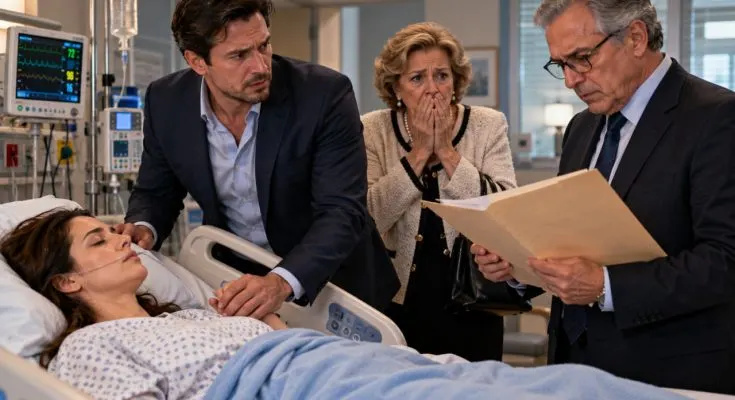
“And he told her to increase my dose.”
Dr. Ibarra closed the folder.
“Thank you for telling me. Your statement will need to be documented and handled carefully. We will not draw conclusions before the evidence is reviewed, but those are serious allegations.”
I nodded.For the first time, I understood why my father had written that I should let the evidence speak first.
I had spent my life believing that the truth would be obvious once someone heard it.
But the truth needed witnesses.
It needed records.
It needed people who could not be bought, frightened, or persuaded to look the other way.
And it needed me to stay alive long enough to tell it.
That evening, Marcos returned.
I knew it was him before he spoke.
His footsteps were familiar, as was the faint scent of his cologne. For three years, that smell had meant home to me.
Now it made my stomach tighten.
He entered carrying a bouquet of white roses.
“Elena, my love.”
His voice was soft, almost breaking.
“I heard you’re awake.”
I kept my eyes closed.
Dr. Chen had warned me not to exhaust myself, and Dr. Ibarra had advised me not to discuss the investigation until the appropriate safeguards were in place.
I didn’t know whether Marcos had already been questioned.
I didn’t know what he had been told.
But I knew one thing.
He could not be allowed to see how much I remembered.
He approached my bed.
“Sweetheart?”
I heard the roses being placed on the table.
Then the mattress shifted as he sat beside me.
“I was so worried.”
His hand touched mine.
I fought the urge to pull away.
“I haven’t slept properly in seven days,” he continued. “I’ve been praying every night.”
A bitter thought rose inside me.
Praying for what, Marcos?
For my recovery?
Or for the money?
He sighed.
“Your mother-in-law has been here every day. She’s been so worried too.”
I almost laughed.
Then he lowered his voice.
“There’s something I need you to understand, Elena. If you can hear me, don’t let anyone confuse you when you wake up. Your father left complicated financial arrangements, and some people may try to interfere.”
My heart beat faster.
He knew about the documents.
Perhaps he had spoken to Carmen.
Perhaps he had already discovered that the hospital was reviewing his actions.
“Your father didn’t trust many people,” Marcos continued. “He always made things more difficult than they needed to be.”
His fingers tightened around mine.
“But I can protect you. I can make all of this easier. You just have to trust me.”
I remained still.
For several seconds, he said nothing.
Then his voice changed.
The sweetness disappeared, leaving something colder beneath it.
“You know, Elena, I never understood why you kept that house.”
I felt his thumb move against my hand.
“It’s old. It’s expensive. It has problems that need fixing. You could sell it, invest the money, and live comfortably for the rest of your life.”
He paused.
“Your father isn’t coming back.”
The words struck me like a slap.
I wanted to open my eyes and tell him that my father was more present in that room than Marcos could ever be.
But I stayed silent.
Marcos leaned closer.
“And if you do wake up, we need to talk about the paperwork. Carmen has already spoken to the attorney. It’s all very straightforward.”
He waited.
I didn’t move.
“Elena?”
Nothing.
His breathing grew heavier.
“Don’t make this difficult.”
There it was.
Not a declaration of love.
Not a prayer for my recovery.
An instruction.
He straightened and walked toward the door.
Before leaving, he stopped.
“You know what the worst part is?” he whispered.
I listened.
“I really did love you once.”
The door opened.
Then closed.
I lay perfectly still, staring into the darkness behind my eyelids.
Perhaps some part of him had loved me once.
Perhaps the beginning of our marriage had contained real affection mixed with selfishness, ambition, and secrets.
I would never know for certain.
But even if his love had once been real, it did not excuse what he had chosen to do.
Love did not give him ownership of my body.
Marriage did not give him ownership of my inheritance.
And the years I had spent trusting him did not obligate me to trust him now.
When the nurse returned, I opened my eyes.
“Please,” I whispered.
She leaned close.
“I need you to call Dr. Chen.”
“Of course.”
“And Dr. Ibarra.”
She nodded.
I swallowed, gathering the strength to speak.
“I want to make a statement.”
The nurse’s expression became serious.
“All right, Elena.”
I looked toward the closed door.
“And I want someone to protect my father’s house.”
Three days after I woke from my coma, I learned that my husband had made one final mistake.
He believed I was still the frightened woman who would apologize for questioning him.
He believed that if he spoke softly enough, held my hand long enough, and called me sweetheart often enough, I would eventually sign whatever he placed in front of me.
He had forgotten one important thing.
I was Arthur Robles’s daughter.
And my father had taught me that the truth could remain hidden for years, but it could never become something else.
The morning after I made my statement, Dr. Ibarra returned with two investigators. They listened carefully as I described what I had heard while pretending to remain unconscious.
I told them about the medication.
I told them about the forged signature.
I told them about the proposed guardianship and the money Carmen had mentioned.
They recorded everything.
Later that afternoon, the hospital confirmed that my medication history and treatment orders would be independently reviewed. Dr. Salgado was removed from my care while the hospital investigated the circumstances surrounding his orders. I was also informed that any suspected criminal conduct would be referred to the appropriate authorities.
I didn’t feel victorious.
Not yet.
I was still weak, and every time I closed my eyes, I remembered Marcos standing beside my bed, asking someone to increase my dose.
But I was no longer helpless.
And that made all the difference.
Two days later, I was discharged to a secure rehabilitation facility, where independent doctors continued monitoring my recovery.
Marcos called seventeen times.
Carmen called eleven.
I answered neither.
Instead, I called my father’s attorney, Margaret Ellis.
She had known my father for almost twenty years. When she heard my voice, she remained silent for a moment.
Then she said, “Elena, your father told me this day might come.”
I closed my eyes.
“He knew Marcos would do this?”
“I cannot tell you that he knew exactly what would happen. But he had concerns about your husband’s intentions, and he prepared for the possibility that someone might try to exploit your vulnerability.”
“Why didn’t he tell me?”
“Because he was afraid you would confront Marcos without evidence. Your father knew how fiercely you defended the people you loved.”
I looked out the window at the Manhattan skyline.
“I defended the wrong person.”
“No,” Margaret said gently. “You loved someone who didn’t deserve your trust. That is not the same thing.”
For the first time in days, I allowed myself to cry without feeling ashamed.
Then I wiped my face.
“Margaret, I need to go to Brooklyn.”
“Not alone,” she replied immediately.
“I want to see the house.”
“I understand. But we need to arrange protection and make sure the property is secure. Your father left specific instructions concerning the locked room.”
I sat up straighter.
“What instructions?”
Margaret hesitated.
“Elena, there is something I haven’t told you yet.”
My fingers tightened around the phone.
“What?”
“The locked room contains more than your father’s personal papers. It contains the original records of a company he helped establish nearly thirty years ago. Those records explain why your father became so protective of the property.”
“Was he hiding money?”
“No. He was protecting something much more complicated.”
She paused.
“And I believe Marcos knows it.”
The following Monday, I returned to Brooklyn.
The neighborhood looked exactly as I remembered it.
Children rode bicycles along the sidewalks. A woman watered flowers outside her brownstone. The smell of fresh bread drifted from the bakery on the corner.
For a moment, I felt as though I had returned to a world where nothing terrible had happened.
Then I saw my house.
The yellow front door needed repainting. The bougainvilleas had grown wild along the fence. My father’s old wind chime still hung beside the porch, turning gently in the autumn breeze.
I had not visited since his funeral.
I had been too busy trying to rebuild my life after losing him.
Then Marcos had filled that empty space.
Now, standing before the house, I realized that I had spent three years trying to create a new home while gradually surrendering the one my father had given me.
Margaret stood beside me with two security officers and a locksmith.
“Are you ready?” she asked.
I nodded.
The front door opened with a familiar creak.
Inside, everything smelled of dust, wood polish, and memories.
The yellow kitchen tiles were still there.
The old dining table stood beneath the window where my father used to read the newspaper.
His gardening gloves remained beside the back door.
I touched the table.
For years, I had believed that grief was the hardest thing a person could survive.
I was beginning to understand that betrayal could be worse, because grief took away someone you loved, while betrayal made you question whether the love you remembered had ever been what you thought it was.
Margaret led me upstairs.
At the end of the hallway stood the locked room.
The door was dark brown, with a brass handle that had grown dull over the years.
I remembered being a little girl and asking my father what was inside.
“Nothing you need to worry about yet,” he would say.
“Why do you lock it?”
“Because some things are valuable, sweetheart.”
“Like money?”
He would smile.
“Sometimes the most valuable things aren’t money.”
I had thought he meant photographs or old letters.
Now I stood before that same door, wondering how much of my life had been shaped by the secret behind it.
Margaret handed the locksmith a key.
He tried it.
The lock turned.
The door opened.
I expected to see a storage room.
Instead, I found a small office.
There was a wooden desk, a filing cabinet, a safe, and shelves filled with carefully labeled boxes.
On the wall hung a framed photograph of my father standing beside four other men.
One of them was Marcos.
I froze.
“Margaret.”
She followed my gaze.
“Yes,” she said quietly. “That is one of the reasons your father wanted you to see this room with me present.”
I stepped closer to the photograph.
“When was this taken?”
“About eight years ago.”
Before Marcos and I met.
Before our wedding.
Before he ever held my hand and told me he loved me.
“What was he doing here?”
Margaret opened a folder on the desk.
“Your father was an early investor in a technology and property management company called Northbridge Holdings. Marcos worked for one of its financial subsidiaries for a period of time.”
“Marcos told me he had worked in consulting.”
“That may be technically true. He did not tell you the entire story.”
Margaret laid several documents on the desk.
Northbridge had originally been established to finance affordable housing and renovate neglected residential properties. My father had invested a substantial portion of his savings because he believed that profitable businesses could still serve ordinary families.
He had also helped establish a charitable foundation that supported housing assistance for elderly people and families struggling to pay rent.
But several years later, discrepancies began appearing in the company’s accounts.
Money was transferred between subsidiaries.
Properties were sold at suspiciously low prices.
Loans were approved for companies with no clear business purpose.
My father questioned the transactions.
Some executives resigned.
Others insisted everything was legitimate.
Then my father discovered that one of the subsidiaries had been used to move money through a network of shell companies.
The investigation had never been fully resolved.
“What does this have to do with me?” I asked.
Margaret turned to another page.
“Your father eventually discovered that some of the people connected to those transactions were attempting to acquire his shares in Northbridge. He refused to sell them.”
“Was Marcos involved?”
“We have documents showing that Marcos communicated with people connected to the disputed transactions. We also have evidence that he asked questions about your father’s estate before you met.”
My hands began to shake.
“So he approached me because of the money.”
“We cannot establish every motive from the documents alone,” Margaret replied. “But the timing is troubling.”
I stared at the photograph again.
Marcos stood beside my father, smiling.
My father had his hand on the young man’s shoulder.
I wondered whether he had once believed Marcos was trustworthy.
I wondered whether my father had blamed himself for introducing him into the wider circle of people connected to his business.
Then Margaret opened a second folder.
“There’s something else.”
Inside was a copy of an agreement signed by my father and several original investors.
The document established that a controlling block of shares had been placed in a trust.
My father’s shares were included.
The trust was designed to prevent a single person from acquiring control through pressure, deception, or the forced transfer of an individual investor’s assets.
I read the document twice.
“Who controls the trust now?”
Margaret looked directly at me.
“You do, Elena. You are its designated beneficiary and voting representative, subject to the trust’s terms.”
I stared at her.
“Me?”
“Yes.”
“How much is it worth?”
“The value depends on the current assets, liabilities, and the outcome of the company’s financial review. But the trust’s holdings are substantial.”
I sat down.
For years, I had believed my father had left me a modest inheritance and a house full of memories.
Now I was discovering that he had also left me a responsibility.
And it was a responsibility that someone had apparently been trying to obtain long before I understood what it meant.
“Why would Marcos need me to sign a guardianship document?” I asked.
Margaret placed another paper on the desk.
“Because if someone could convince a court that you were incapable of managing your affairs, they might attempt to gain authority over certain financial decisions. That would not automatically give them ownership of the trust, but it could create an opportunity to challenge or interfere with its administration.”
I looked at the paper.
It was a draft petition for temporary guardianship.
My name appeared at the top.
Beneath it were statements suggesting that I had been unable to make rational financial decisions since my father’s death.
The document claimed I had become confused, emotionally unstable, and incapable of understanding complex legal matters.
None of it was true.
I looked at Margaret.
“Who prepared this?”
“The draft bears the name of an attorney who has since denied submitting it to any court. We are investigating how it was prepared and whether it was intended to be filed using forged supporting documents.”
I felt sick.
They hadn’t merely wanted my money.
They had planned to make the world believe I was incapable of protecting myself.
And if they had succeeded, every protest I made might have been dismissed as the rambling of a woman who could no longer be trusted.
My father had understood the danger.
That was why he had insisted on independent verification.
That was why the trust had safeguards.
And that was why the locked room existed.
I turned toward the safe.
“What is inside?”
Margaret looked at the locksmith, then at me.
“Your father left instructions that the safe could be opened in your presence after the conditions in his letter were met.”
The locksmith entered the combination Margaret had received from the estate’s executor.
The safe opened.
Inside were several envelopes, a small digital recorder, a stack of financial records, and a sealed package addressed to me.
I picked up the package.
My name was written across it in my father’s handwriting.
I opened it carefully.
Inside was a letter.
PART 5
Elena,
If you have reached this point, you have discovered that the house was never the whole inheritance.
I am sorry I could not explain everything to you in person.
I hope you will remember that money is not the measure of a person’s worth. It is simply a tool, and tools can be used to build something good or something terrible.
You may discover that some people approached you because of what you possessed. Do not let their greed convince you that everyone is untrustworthy.
There are still good people in the world. Learn to recognize them by their actions, especially when doing the right thing costs them something.
The documents in this safe may help you establish what happened at Northbridge. Give them to the proper investigators. Do not attempt to settle the matter privately, and do not let anyone pressure you into signing away your rights.
If Marcos is involved, remember this: you do not have to destroy him to save yourself.
You only have to stop protecting him from the consequences of his own choices.
Live well, my daughter.
That is the one thing I have always wanted for you.
I pressed the letter to my lips.
Then I looked at the digital recorder.
“Margaret, what’s on that?”
“Your father left a note instructing us to give it to investigators if evidence of fraud or coercion emerged.”
“Can we listen to it?”
She thought for a moment.
“We can, but we should preserve the original and make a verified copy. If the recording contains relevant evidence, the investigators should receive it without any risk of alteration.”
I nodded.
For once, I wasn’t going to rush toward an answer just because I was frightened of what it might reveal.
We documented the contents of the safe, photographed the records, and arranged for the relevant materials to be preserved and reviewed.
Then Margaret made a call.
Within an hour, the investigators handling the suspected medical misconduct had been informed that the house contained potentially relevant financial evidence.
And somewhere across the city, Marcos was about to discover that the woman he had tried to silence had found the one thing he could never take from her.
The truth.
The first real break in the investigation came from a bank record.
A transfer had been made several weeks before my hospitalization from a company connected to Marcos to an account controlled by an entity associated with Carmen.
The amount was not enormous compared with the assets my father had left behind.
But the transaction’s timing was significant.
It occurred shortly before Carmen began urging me to sell the Brooklyn house.
Investigators found additional records suggesting that someone had been preparing documents related to my inheritance and the Northbridge trust.
They also discovered communications concerning a proposed transfer of certain voting rights if I were declared incapable of managing my affairs.
The evidence did not prove every allegation against Marcos or Carmen.
But it established enough questions that the authorities began examining their activities more closely.
Meanwhile, the hospital’s investigation uncovered serious inconsistencies in the medication orders entered during my coma.
The hospital reported the concerns through its established procedures, and investigators began reviewing whether anyone had deliberately administered medication to keep me incapacitated.
I gave additional statements.
Dr. Chen provided medical documentation.
The nurses who had questioned the orders explained what they had observed.
Dr. Ibarra supplied the records showing that my father had anticipated possible attempts to obtain guardianship through medical manipulation.
Piece by piece, the wall around Marcos began to crumble.
He responded the way I expected.
First, he called me repeatedly.
Then he sent flowers.
Then came the messages.
Elena, please call me.
You don’t understand what’s happening.
Your father was suspicious of everyone. Don’t let his paranoia destroy our marriage.
We can work this out privately.
Finally, he sent a message that made me put down my phone.
If you really loved me, you wouldn’t do this to me.
I read it twice.
Then I deleted nothing.
I forwarded the message to my attorney.
Because for three years, Marcos had taught me to think of love as an obligation to forgive him.
Now I understood that forgiveness was not the same as surrender.
And I was no longer willing to surrender.
Two weeks later, Marcos appeared at the Brooklyn house.
I was sitting at the kitchen table with Margaret, reviewing the next steps for the trust.
The doorbell rang.
One of the security officers checked the camera and came to tell us who was outside.
“Your husband is here.”
My stomach tightened, but I didn’t stand.
“Did he say why?”
“He says he wants to speak with you privately.”
Margaret closed the folder.
“You do not owe him a private conversation.”
“I know.”
I looked toward the window.
Marcos stood on the porch holding a brown envelope.
He wore the navy coat I had bought him for our second anniversary.
For a moment, the sight brought back a memory of the two of us walking through Central Park in the winter, laughing because the wind kept turning our umbrellas inside out.
I remembered how he had held me when I cried after my father’s funeral.
I remembered how safe I had felt in his arms.
Then I remembered his voice beside my hospital bed.
Increase her dose.
I stood.
“I’ll speak to him from the doorway. You stay nearby.”
Margaret nodded.
The security officer opened the door but remained beside me.
Marcos looked thinner than I remembered.
His hair was uncombed, and dark circles had appeared beneath his eyes.
“Elena.”
He sounded relieved.
“Thank God. I’ve been trying to see you for days.”
“What do you want?”
He looked at the security officer.
“Can we talk alone?”
“No.”
His face changed.
Only for a second.
Then he forced a smile.
“All right. I understand you’re upset.”
I said nothing.
He held out the envelope.
“I brought some documents. I want you to read them before you make any decisions.”
I didn’t take it.
“What are they?”
“Financial documents. Things your father left behind. You don’t understand how complicated this situation is.”
“I understand that you wanted medical guardianship over me.”
His smile disappeared.
“That’s not what happened.”
“I heard you.”
“Elena, you were unconscious. You don’t know what you heard.”
“I heard you tell Carmen to increase my dose.”
He stared at me.
For the first time since I had known him, he seemed unable to find the right words.
Then he looked toward the street.
“I was worried about you.”
“Worried?”
“You weren’t waking up. The doctors said they needed to manage your condition. I was trying to help.”
“Then why did you laugh when you thought I could hear you?”
His face went pale.
I took a breath.
“Why did you practice my signature? Why did you want to sell my father’s house? Why were you asking about my inheritance before we even met?”
He shook his head.
“Your father poisoned you against me.”
“No. My father left documents. The hospital has medical records. The investigators have statements. You gave me the answers yourself.”
His eyes filled with tears.
And for one brief moment, I saw the man I had once loved.
Or perhaps I saw the man I had wanted him to be.
“Elena, please,” he whispered. “We built a life together.”
I felt my throat tighten.
“Yes, Marcos. We did.”
“I loved you.”
“Maybe you did.”
His head lifted, hope appearing in his eyes.
Then I continued.
“But whatever love you once felt for me, it didn’t stop you from treating my life as an obstacle to your plans.”
He began to cry.
“I made mistakes.”
“You made choices.”
“I was under pressure. Carmen was involved in things I didn’t understand. The company was falling apart. I thought I could fix everything if I could get access to the trust.”
“By making me disappear inside my own body?”
He covered his face.
“I never wanted you to die.”
I looked at him for a long moment.
“That is supposed to make me feel better?”
He lowered his hands.
“I didn’t think it would go this far.”
I felt something inside me settle.
Not anger.
Not hatred.
Certainty.
“You didn’t think about what would happen to me,” I said. “You thought about what would happen to you if I woke up.”
He looked at me, unable to deny it.
I finally accepted the envelope.
Not because I trusted him.
Because I wanted the investigators to examine whatever he had brought.
“You should leave, Marcos.”
“Elena—”
“Any further communication should go through my attorney.”
His face twisted.
“You’re really going to destroy our marriage over this?”
I stared at him.
“No, Marcos. You destroyed our marriage when you decided my life was worth less than what you wanted from it.”
I handed the envelope to Margaret.
Then I stepped back inside.
The door closed between us.
I stood in the hallway, trembling.
It hurt.
Of course it hurt.
Ending a marriage did not erase the years I had spent believing in it. Betrayal did not turn every happy memory into a lie.
But I had finally stopped confusing the pain of losing someone with the obligation to keep letting them hurt me.
And for the first time, I could imagine a future that belonged entirely to me.
The following month, the investigation took a decisive turn.
The documents Marcos had brought contained a draft agreement proposing that certain rights connected to the Northbridge trust be transferred to a company controlled by people associated with the disputed transactions.
The draft had never been properly executed.
It also contained language suggesting that my approval would be required before the transaction could proceed.
My signature appeared on one page.
I had never signed it.
A forensic document examiner later found indications that the signature might have been copied or reproduced from another document. The examiner’s findings became part of the investigation.
Meanwhile, investigators obtained additional records through lawful procedures. Those records raised further questions about communications between Marcos, Carmen, and several individuals connected to Northbridge.
Carmen initially denied knowing anything about the proposed transfer.
Then the investigators showed her a series of messages.
Her denial became silence.
I wasn’t present when she was questioned, and I didn’t need to be.
For years, I had imagined confronting Carmen in front of everyone who had ever believed her charming stories about being a devoted mother.
I had imagined making her admit everything.
But as the investigation progressed, I realized that I no longer needed to witness every moment of her downfall.
I needed to rebuild my life.
The authorities eventually brought formal allegations against individuals they believed were involved in the suspected financial misconduct and the attempt to obtain control over my affairs. The proceedings took time, and the evidence against each person was assessed separately.
Marcos was not allowed to resolve the matter through a private promise or an apology.
Carmen could no longer dismiss my concerns as the emotional accusations of a grieving daughter-in-law.
And Dr. Salgado’s conduct remained under separate investigation.
I learned to let the process move at its own pace.
Some days were difficult.
I woke from nightmares and reached for a husband who was no longer beside me.
I found myself wanting to call Marcos when something funny happened, only to remember that the man I wanted to call was the man I had believed him to be.
I cried while sorting through old photographs.
I felt ashamed that I hadn’t recognized the warning signs.
Then I remembered my father’s words.
You were not foolish for loving someone.
Slowly, I stopped punishing myself for having trusted.
The responsibility belonged to the people who had chosen to exploit that trust.
Not to the woman who had offered it.
Six months after my hospitalization, the first major legal resolution arrived.
Several of the disputed financial transactions had been reversed or secured pending the outcome of the remaining proceedings. The trust’s independent administrators strengthened its protections, and the estate’s records were placed under professional oversight.
The investigation into my hospitalization also resulted in formal action against those the authorities believed had participated in the alleged misconduct. Some allegations remained contested, and not every question was resolved immediately, but the evidence was no longer being ignored.
I filed for divorce.
Marcos initially opposed it.
He sent letters through his attorney claiming that our marriage had been damaged by misunderstandings, outside interference, and my father’s distrust.
But there was no misunderstanding about what I had heard beside my hospital bed.
There was no misunderstanding about the forged documents.
And there was no misunderstanding about the fact that I no longer felt safe with him.
The divorce proceedings were painful, but they were clear.
My father’s house remained protected under the trust arrangements he had established. My personal inheritance remained subject to its own legal safeguards, and no one was permitted to take control of my finances merely because I had once been unable to speak for myself.
When the divorce was finalized, I signed the final papers without shaking.
Marcos sat across the room.
He looked at me as if he expected me to say something.
Perhaps he wanted me to forgive him.
Perhaps he wanted me to tell him that the years we had shared meant he could still come back.
I looked at him once.
“I hope you become a better person,” I said.
He lowered his eyes.
“But I will never again make myself vulnerable to you.”
Then I walked out.
I did not feel triumphant.
I felt free.
A year after I woke from the coma, I returned to the Brooklyn house on a quiet Saturday morning.
Spring had arrived.
The bougainvilleas had grown thick along the fence, and the garden was filled with the colors my father had loved.
I spent the morning cleaning the kitchen and opening the windows.
Then I went upstairs and unlocked the room that had once seemed like a mystery.
It was no longer frightening.
The documents were safely preserved. The important records had been transferred to secure storage, and the trust was being administered with independent oversight.
I had decided to turn the room into a small study.
I placed my father’s photograph above the desk and arranged his gardening books on the shelves.
On the wall, I hung a framed copy of his final letter.
Not the entire letter.
Just one sentence.
You do not have to destroy someone to save yourself. You only have to stop protecting them from the consequences of their own choices.
I sat beneath it for a long time.
Then I began working on something my father had started but never finished.
A housing assistance program connected to the charitable foundation he had established.
The foundation would help older people facing financial exploitation, provide support for families struggling with housing costs, and connect vulnerable individuals with independent legal advice.
I wanted it to be useful.
Not a monument to my suffering.
Not revenge disguised as charity.
Something that could help people before they found themselves in a hospital bed, wondering whether the person holding their hand was waiting for them to wake up or hoping they never would.
The first program opened several months later.
We began with a modest number of families.
One of them was an elderly woman named Margaret Lewis, who had nearly signed away her home after a relative convinced her she could no longer manage her affairs.
When she sat across from me in the foundation’s small office, she held my hands and began to cry.
“I thought I was alone,” she whispered.
I squeezed her fingers.
“You’re not alone anymore.”
After she left, I went into the garden.
I stood beneath the bougainvilleas and looked up at the windows of my father’s house.
For the first time in years, the place felt peaceful.
Not because the memories had disappeared.
Because they no longer controlled me.
I had lost my husband.
I had lost the future I thought we would share.
I had lost the comforting belief that the people closest to me would never deliberately hurt me.
But I had not lost myself.
And that was enough to begin again.
Two years later, I received one final letter from Marcos.
It arrived through my attorney, along with confirmation that the remaining legal proceedings connected to our marriage had been concluded.
I almost asked Margaret to dispose of it.
Then I decided to read it.
Marcos wrote that he was sorry.
He admitted that greed, fear, and his desire to regain control over his financial circumstances had influenced his decisions. He acknowledged that he had treated my trust as something he was entitled to exploit.
He said he had spent a long time trying to convince himself that he had never intended to hurt me.
Eventually, he wrote, he understood that intention did not erase consequences.
At the end of the letter, he asked whether I could ever forgive him.
I read the final paragraph twice.
Then I folded the letter and placed it in a drawer.
I did not write back.
Not because I wanted him to suffer.
Not because I wanted to punish him forever.
But because forgiveness did not require me to reopen a door I had worked so hard to close.
Perhaps one day I would forgive him completely.
Perhaps I already had, in the quiet way that allowed me to think of him without wanting revenge.
Either way, my future no longer depended on his understanding.
That evening, I sat in the garden with a cup of tea.
The sun was setting behind the rooftops, painting the sky in shades of gold and pink.
I thought about the woman I had been when I entered that hospital.
I had believed that wealth made me secure, marriage made me loved, and trust made me safe.
I understood now that none of those things could guarantee happiness.
Real security came from knowing my rights.
Real love required respect.
And real trust could never demand that I ignore the truth.
I took my father’s letter from my pocket and read the final lines again.
Live well, my daughter.
That is the one thing I have always wanted for you.
I looked toward the garden he had planted.
Then I smiled.
Not because everything that had happened was fair.
Not because the pain had vanished.
But because, after everything, I was still here.
My husband had tried to make me powerless.
He had believed my silence would become his freedom.
He had mistaken my kindness for weakness and my love for permission.
But I had survived.
I had reclaimed my voice, protected my father’s legacy, and built something meaningful from the wreckage he had left behind.
And the greatest victory was not that Marcos had lost me.
It was that I had finally found myself.
The End.
This article is general information, not personal medical or financial advice. Talk to a qualified professional about your own situation.