The Masterpiece on Royal Street: The $40 Thrift Store Painting That Brought Down a Billionaire Dealer
PART 1
The moment the smug billionaire gallery owner laughed in my face and offered me fifty bucks for my grandfather’s dying legacy, he had no idea he was signing the warrant for his own destruction.
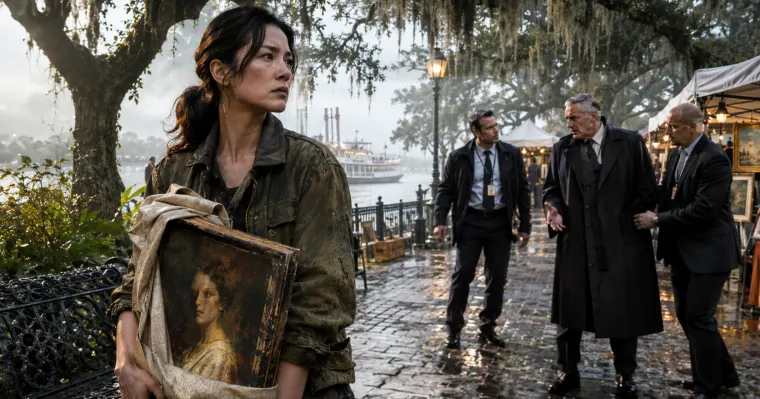
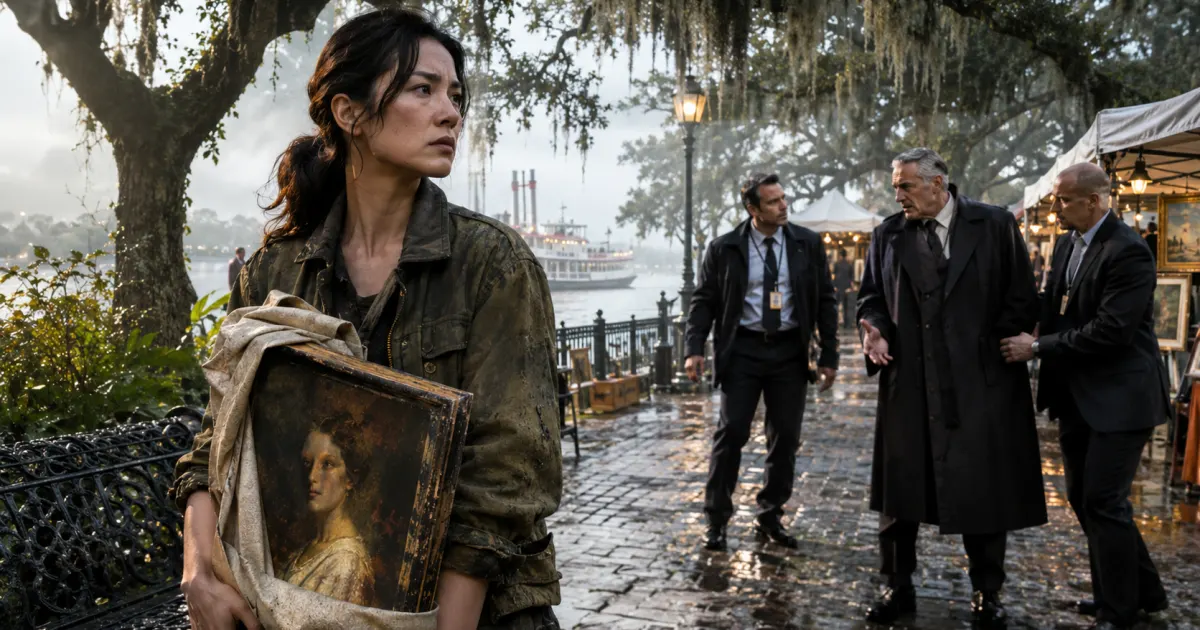
My name is Maya Lin. I’m a thirty-two-year-old forensic art conservator working out of a cramped attic studio in the French Quarter of New Orleans. Six months ago, my grandfather, Peter Lin—a master restorer who spent fifty years working in the shadows of high-end private collections—passed away from lung cancer. He left me nothing but an old wooden easel, twenty-two jars of handmade linseed pigments, and a battered, smoke-stained canvas depicting an overcast marshland under heavy rain.
On his deathbed, his voice was barely a rasp: “Maya, don’t ever sell the marshland to an auction house. Take it directly to Victor Vance on Royal Street. Tell him Peter Lin sent his regards, and ask for seventy thousand dollars. He will pay. He has no choice.”
Victor Vance was royalty in the international art scene. A silver-haired, impeccably tailored titan who hosted private vernissages for oligarchs and movie stars, Vance had built an empire authenticating lost European treasures.
The following Monday, I carried the framed canvas into his gleaming, chandelier-lit gallery on Royal Street. Victor Vance looked down at my worn canvas sneakers, glanced at the grimy oil paint, and scoffed.
Also readI Found a Hidden Wall in an Old Warehouse—Hours Later, I Was Running for My Life“Your grandfather was an eccentric old canvas scrubber, young lady,” Vance sneered, not even bothering to put on white handling gloves. “This is amateur student work from the 1920s. It’s worthless sentimental junk. I’ll give you fifty dollars for the antique cypress wood frame out of charity.”
I looked him dead in the eye. “My grandfather said to tell you: Peter Lin sends his regards.”
Vance froze. For a split second, the color drained entirely from his face, replaced by a flash of pure venom. But he quickly regained his composure, let out a harsh laugh, and signaled two hulking private security guards in black suits.
“Get this lunatic and her garbage out of my gallery before I call the police,” Vance snarled.
They threw me out onto the humid cobblestones of Royal Street. My knee hit the pavement hard, and the wooden frame cracked on the curb. Passersby stared, but Vance stood behind the thick plate glass window, raising his glass of sparkling water with a mocking, victorious grin.
Humiliated, bleeding, and trembling with rage, I carried the ruined painting back to my workshop under the dim streetlamps of Bourbon Street.
I set the canvas under high-intensity ultraviolet spectrum light and pulled out a surgical scalpel. I began shaving away the surface oil layers with surgical precision, using micro-swabs soaked in acetone and mineral spirits.
By 3:00 AM, the cheap, muddy marshland paint began to dissolve. Beneath the superficial 1970s oils, an entirely different chemical signature emerged: seventeenth-century egg tempera, genuine lapis lazuli, and the distinct, unmistakable hand of the Dutch Golden Age.
Underneath the fake swamp was a masterpiece thought to be destroyed eighty years ago. But that wasn’t the shock. Hidden between the canvas weave and the oak lining was a microscopic microdot film negative and a hand-signed confession on French Ministry letterhead dated August 1944.
Victor Vance wasn’t just an arrogant dealer. He was sitting on a mountain of stolen blood money—and the key to his entire empire was now sitting under my microscope.
THE STORY CONTINUES ON THE NEXT PAGE… 👇👇👇
This article is general information, not personal medical or financial advice. Talk to a qualified professional about your own situation.