The Masterpiece on Royal Street: The $40 Thrift Store Painting That Brought Down a Billionaire Dealer
PART 2
The documents preserved inside the lining detailed the darkest secret in modern art history.
In the summer of 1944, as Allied forces closed in on Paris, a young logistics clerk named Roland Vance—Victor Vance’s father—was assigned to catalog looted art collections held in safe houses along the Rhine. Roland didn’t return the crates. He faked an artillery fire report, embezzled seventeen priceless European masterworks, smuggled them to South America, and later laundered them through private foundations in New Orleans.
My grandfather, Peter Lin, was the brilliant young Chinese-American immigrant chemist hired in 1968 to strip, re-varnish, and create untraceable provenance papers for the stolen works. When Peter realized the horrifying scale of what he had aided, he hid the original inventory ledgers and microfilm proof inside this single decoy canvas—a leverage policy to keep Roland Vance and his ruthless son Victor from silencing him.
When Victor Vance threw me out of his gallery, he assumed my grandfather had died without ever showing me how to read the canvas. He thought the secret was dead and buried.
He was wrong.
Also readThe Lighthouse Ridge: My Brother Left Me to Rot in a Foreign Cell for Ten Years, but Our Mother Left the Cliffside Empire to the Dead SonI didn’t take the story to the local police—Vance donated millions to city campaigns and owned the district board. Instead, I called the FBI Art Crime Team in Washington and Claire Dubois, the senior heritage curator at the Musée d’Orsay in Paris.
For three weeks, we laid the trap.
Through an anonymous intermediary, I leaked a rumor to Vance’s private procurement agent that an eccentric French tourist had brought an uncataloged 1640s Dutch oil panel to an outdoor flea market on Frenchmen Street, asking for quick cash. To make the bait irresistible, I had the FBI release a redacted snippet of my grandfather’s old ledger through an international art blog.
Paranoid that someone else had found the hidden stash, Vance personally broke his rule of never meeting sellers in public.
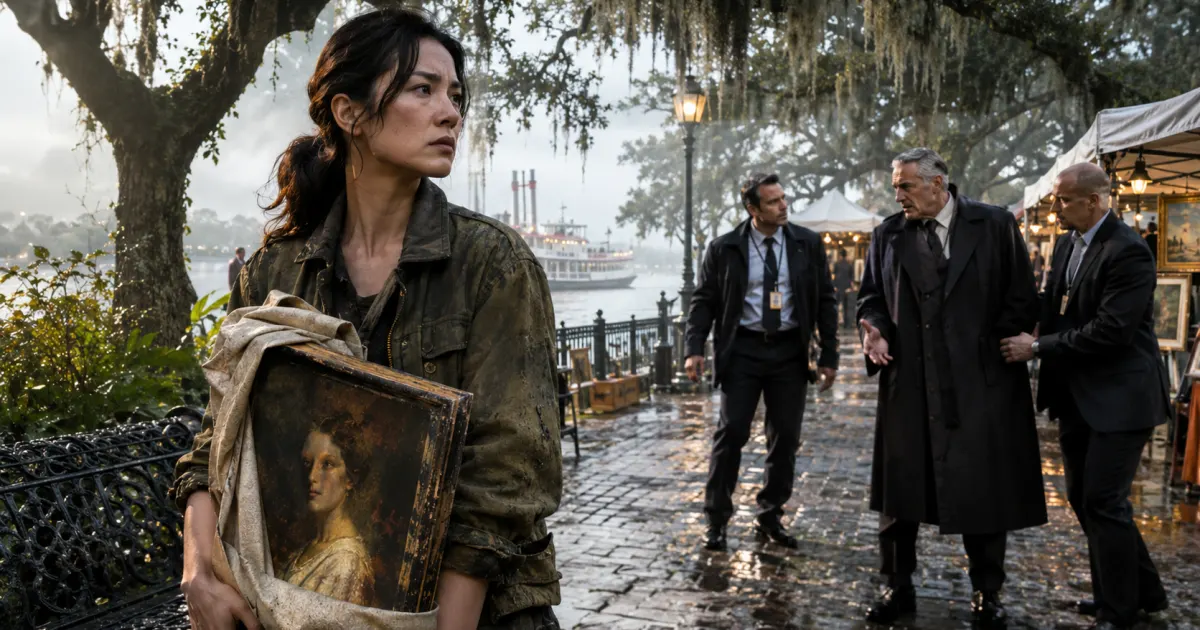
On a foggy Sunday morning at 6:30 AM, Victor Vance arrived alone at the outdoor flea market near the Mississippi River levee, dressed in an oversized trench coat, carrying a briefcase packed with $250,000 in cash.
I was sitting on an iron park bench beneath the live oak trees, holding the stripped, glowing masterpiece in a canvas sleeve.
Vance walked up to me, his breath visible in the chilly damp river air. “Give me the canvas, Maya. The cash in this briefcase is yours. Take it and disappear. You don’t know who you’re dealing with.”
“I know exactly who you are, Victor,” I said calmly.
He reached inside his trench coat—not for money, but for a can of industrial aerosol paint stripper to destroy the canvas right in front of me before any authentication could be proven.
“Drop your hands! Federal agents!”
Before Vance could uncap the spray, four plainclothes agents emerged from behind the open-air market stalls, weapons drawn. Tactical officers pinned Vance face-down onto the damp grass, cuffing his hands behind his back.
The story exploded worldwide. Forensic analysis of the microdot files confirmed that twelve masterpieces currently hanging in Vance’s private estate were stolen historical heirlooms. Federal prosecutors seized over $180 million in illicit gallery holdings, freeze-framed his offshore accounts in the Cayman Islands, and indicted him on twenty-four counts of racketeering, wire fraud, and handling stolen cultural property.
Three months later, I stood in the main hall of the French Ministry of Culture in Paris as the recovered masterpiece was unveiled under its rightful name, returned to the descendants of the original family.
As for me, I received a 10% international recovery finder’s fee amounting to $4.2 million. I didn’t open a fancy commercial showroom. I bought my grandfather’s old workshop building outright and turned it into a free public training academy for young, underprivileged art conservators.
On the front brick wall of the academy, right across from where Vance’s shuttered gallery used to stand, I hung an iron plaque:
“True art cannot be bought with stolen blood. Peter Lin sends his regards.”
This article is general information, not personal medical or financial advice. Talk to a qualified professional about your own situation.