Four Months After My Brother Sold Our Father’s Wristwatch For Bar Money, A Stranger Stood On My Mother’s Porch Holding A Velvet Box, And What Came Out Of That Day Changed Every One Of Us
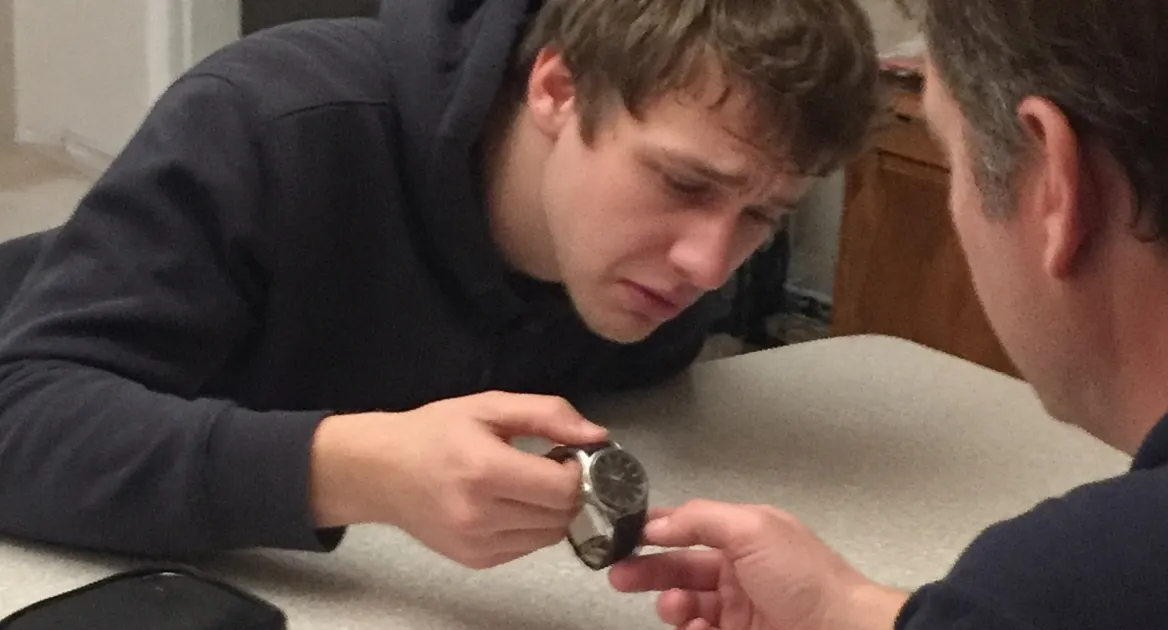
My mother read the note without making a sound, and then she read it again, and then she held it out to me, because she could not trust her voice. The writing was my father’s square, careful print, the letters of a man who had learned to write on the back of mill work orders. Dot, if you are holding this, then somebody patient has opened the back of my watch, and I would like you to thank them for me. I looked up and saw Gus standing very still with his cap in his hands. The note went on. I had this closed up on March 9, 1984, by a friend who fixes clocks. I wanted a place to put something where only a person who was not in a hurry would ever find it. Go to Hale and Sons on Marlow Street. Ask for the Kessler file, number 84-117. Hand them this paper. Do not let anybody rush you. I love you more than the hours I have counted on this wrist. At the bottom, in a smaller hand, he had written one last line. Forgive me for waiting so long to tell you. I was a coward about it, but I was never careless. I read that last sentence aloud, and my mother laughed, a short wet sound, and put her hand over her mouth. Then she said, to nobody in particular, “Forty years. He carried a secret on his wrist for forty years, and he never once looked guilty.” Mr. Hale cleared his throat gently and introduced himself as Daniel Hale, the grandson of the man who had founded the firm. He said that the file had been sitting in the vault since 1984 under a single instruction. It was to be released only to Dorothy Kessler, and only if she presented that paper in person. He said his grandfather had told him as a boy that one day a woman might arrive with a scrap of tissue, and that on that day the firm should close its doors to every other client.
We moved inside, and the four of us sat around the kitchen table where my father had died. Mom insisted that Gus stay for coffee, and he accepted it with a look of such quiet relief that I understood he had been bracing himself, for four months, for the possibility that he would be turned away. Mr. Hale opened his briefcase and placed three things on the table. The first was a thick cream envelope, sealed, with Dot written across the front. The second was a green folder of documents, bound with a rubber band that had gone brittle and snapped the moment he touched it. The third was a smaller stack, two more envelopes, one marked Laura and one marked Brian. “Your husband visited our office every year or two for forty-one years,” Mr. Hale said. “Usually on his lunch break, always in his work clothes. He would sit in the front room, add something to the file, and leave. My grandfather used to say that Walter Kessler was the only client who apologized for taking up our time.” He explained the documents one by one. In March of 1984, my father had bought a three-acre lot at Pine Lake, a stretch of pines and bare sand two hours north of our town, for twenty-eight hundred dollars he had earned entirely in overtime. The deed was in my mother’s name alone. In that same month he had opened a savings account at Marlow Savings, in her name as well, and he had put fifty dollars into it every week since, then one hundred, then more, quietly, for the rest of his working life. The balance, with interest, stood at a hundred and eighty-seven thousand, four hundred dollars. My mother stared at the number. “The roof,” she whispered. “He told me the overtime was for the roof.” She laughed again, and this time the laugh broke in the middle, and she covered her face with the dish towel, and I put my arm around her while the coffee went cold on the table.
She opened her own envelope then, and read it slowly, in the quiet of that kitchen, while the rest of us looked at our hands. When she finished, she folded it along its old creases and held it against her chest, and she told us what it said, in her own words, because she said some things were too good to be left only on paper. He had written that in 1984, the mill had been laying off men by the dozen, and he had been terrified. He wanted to give her the lake, the one place she had ever said she wished to retire to, but he could not buy it out loud, because he knew that every time money appeared in the house, it was reached for by someone in need. He had been a coward, he wrote, and he had decided that the only safe place for a promise was a place where nobody could spend it before he was ready to say it. Then the years had gone by, and every time he found the courage, he saw Brian’s face across a table and thought, not yet, he needs this more. He had watched his son go under again and again, and each time, he had reached for his checkbook instead of his wife’s hand. “He says,” my mother said, her voice thin and steady, “that he was sorry he spent so long being a father that he forgot to also be a husband. He says that is what the account is for. For me. For whatever I would like to do with the last good years.” She wiped her eyes. “He wanted me to be seen, Laura. Not just fed, not just kept. Seen.” I took my own envelope with trembling fingers. Inside was a single lined sheet written in the spring before he died. He told me that I had always been the one who stayed, and that staying was its own kind of brave, but that I was allowed to put it down sometimes. He told me the lot at Pine Lake was mine to love as much as hers. He signed it simply, Dad. I did not read any more of it that day. I could not see.
Brian arrived on Sunday evening, unannounced, in a dented truck that coughed to a stop beside the curb. I watched him from the front window, a heavy, tired man of forty-four sitting for two full minutes with his hands on the wheel, as if he were deciding whether the house could still hold him. When he finally came to the door, he looked like a person who had not slept in several days. “Laur,” he said, “I need to say something.” I let him in. Mom was at the kitchen table with the watch beside her, back on its own satin, and when he saw it, all the color left his face. He had not known. Gus’s shop was on the far side of town, and the story had not yet reached the tavern. He lowered himself into a chair across from her. “Mom, I sold it,” he said. “I sold Dad’s watch for thirty-five bucks and I spent it on whiskey. I am so sorry.” He started to say more and could not. My mother did not shout at him. She did not tell him that he had broken her heart, which he had. She reached across the table, took his hand, and turned it over, and set the envelope with his name on it in his palm. “Your father left you something,” she said. “I think he knew.” Brian opened it slowly, and I watched his face while he read, and I will remember that expression for the rest of my life. It crumpled. Then it did something even harder to watch. It softened, as though some part of him that had been braced since childhood had finally been told it could stand down. He read the letter to the end and handed it to me without a word, and I read it aloud, for him, because he asked me to.
Brian. If you are reading this, then you have probably done something you are ashamed of, and I would like to tell you what I know. I never kept score. I paid your debts because I wanted you to know that someone would always catch you, and I was wrong to think that being caught would ever be enough. A father should also say stand up, and I did not say it often. I have watched you carry more shame than I ever carried, and I should have taken some of it off your back instead of paying the bills. There is money set aside for you at Hale and Sons. It will not go into your hand, because I love you too much for that, and it is not a punishment. It will pay for a program, a bed, a landlord, anything that helps you rebuild, and I have asked Mr. Hale to see that nobody gives you a lecture along with it. I am proud of the boy who fixed bicycles for every kid on our street. He is still in there. Please let him out. Brian sat with his elbows on his knees and his face in his hands, and my mother moved her chair next to his and put one hand between his shoulder blades, and she said, very softly, “He saw you the whole time, sweetheart. He just could not figure out how to say it.” Brian nodded, and wept, and nobody in that kitchen spoke for a very long time. At the end of it, he asked quietly if he could carry the watch to Gus and apologize. Mom said that he could, and that he should bring the thirty-five dollars.
He did. He drove to the shop on Monday morning and pressed the crumpled bills into Gus’s hand. Gus looked at the money, then at my brother, and then pushed it back across the counter. “I spent four months looking for your mother,” he said. “Do me one favor and sit with me for an hour. I have a stool, and I have a lot of old watches that need somebody who knows how to be patient.” I did not know it at the time, but that was the beginning of a friendship that would outlast the winter. In February, Brian entered a recovery program in Millbrook, paid for directly from the trust Dad had arranged, and he stayed for ninety days, then another ninety, then moved into a small apartment above a hardware store, where the landlord was paid on the first of each month by a lawyer who never asked a single question. In June, he began working weekdays at Gus’s shop, learning to open the backs of watches the way a surgeon opens a patient, and he discovered that his hands, which had spent years shaking, were remarkably steady when they had something small and fragile to hold. My mother sold nothing and bought nothing. She drove with me to Pine Lake in April and walked the three acres in her good coat, touching the bark of the pines one at a time, and then she sat down on a stump and said that she wanted a small cabin with a porch and a window facing the water. That summer the three of us built the frame ourselves, with Gus on weekends and Mr. Hale, who turned out to be surprisingly good with a level, and Brian on the roof, sober and sunburnt, hammering as if each nail were a sentence he had been waiting to say.
On the first anniversary of the day Gus knocked on our door, we held a small gathering on the porch of the cabin, with a folding table, a pot of coffee, and a plate of lemon bars that Mom had baked in the new oven. The lake was flat and silver, and a loon was calling somewhere out beyond the reeds. Brian stood up before we ate and said that he had been sober three hundred and sixty-five days, and that he had a small thing to give. He reached into his jacket pocket and took out a velvet box, the same one Gus had carried up our porch steps, and he set it in front of my mother. She opened it, and the watch lay there, ticking, polished, and perfectly on time. “Dad did not leave this behind by accident,” he said. “I think he wanted somebody to carry it who knew what it cost. I would like you to wear it, Mom, for as long as you like.” She did not answer. She fastened the new strap around her own thin wrist, a little loose, the case sliding toward her hand, and she held her arm up to the light and turned it back and forth. Then she looked at each of us in turn. She looked at me and at Brian and at Gus, with his cap in his lap, and at Mr. Hale, who was pretending to study the lake. She said that she had spent forty-eight years assuming that love was the thing that happened when no one was looking, and that she had just learned it was the thing that happened when somebody finally was. I thought about the reading glasses, which she had carried up to the cabin and set on the windowsill facing the water, with nothing left beside them but a pair of birds. And I understood that my father had never been a man who hid. He had only trusted that the people he loved would eventually be patient enough to open the back, and look, and find that they had been seen all along.
This article is general information, not personal medical or financial advice. Talk to a qualified professional about your own situation.