A Rich Businessman Took My First Class Window Seat And Told Me I Belonged In Economy Because I Was Fifteen, So I Politely Let Him Keep It And Made One Quiet Phone Call Before Takeoff
The sweater I was wearing that afternoon was not mine. It had belonged to my grandmother, Maeve Caldwell, a soft, oatmeal-colored Aran knit with cables running down the front and a small darned patch on the left elbow where she had caught it on a galley cart sometime in the 1990s. She knitted it herself, the winter she turned fifty, from wool her sister sent from County Kerry. It was too big for me. The sleeves hung past my wrists, and I had to roll them twice. I wore it with my old white sneakers and a pair of plain black leggings, and I carried one small canvas travel bag, because that was all I needed. My name is Nia Caldwell. I was fifteen years old, and on a gray Thursday afternoon in October, I was flying alone from Boston Logan to Dublin on North Star Airlines Flight 467. It was the first time I had ever flown without one of my parents. My father had walked me to the gate himself and hugged me twice and made me promise to text him the moment I landed. Before I left, he said the same thing he had been telling me since I was small enough to sit on his shoulders. He said that confidence doesn’t require shouting. He said, let the facts speak for themselves. My father, Desmond Caldwell, is the kind of man who never raises his voice, not when he is angry, not when he is worried, not even when the Celtics lose in overtime. He believes that calm is a kind of strength most people forget they have. I had heard that advice so many times that I used to roll my eyes at it. That afternoon, I was about to find out exactly how useful it could be.
I had a window seat in First Class, Seat 3A, and I had a very specific reason for wanting it. My grandmother had been a flight attendant with North Star Airlines for forty years, from 1968 until she retired in 2008, mostly on the transatlantic routes from Boston to Shannon and Dublin. She was born in a small stone cottage outside Dingle, on the far western edge of Ireland, and she came to America at nineteen with one suitcase and a job offer from an airline she had never heard of. She used to tell me that the best moment of any flight to Ireland was the very end, just after dawn, when the plane came down out of the clouds over the Atlantic and suddenly there it was out the left side window, the coast of Kerry, green and jagged and impossibly bright against the gray sea. She said that every single time she saw it, for forty years, it made her cry. She said Seat 3A on the old wide-body jets had the best view of it on the whole plane, and she used to sneak me into it in her stories, every bedtime, describing the cliffs and the lighthouse and the little white houses on the hills. My grandmother died in May, at eighty-one. She left me something unusual in her will: the last two hundred thousand of her airline miles, which she had saved for years, with a note that said they were for one trip, my first trip alone, to see her coast from her seat. I had booked Seat 3A with those miles the week after the funeral. And in the small canvas bag at my feet, packed carefully inside a sealed wooden box with all the proper airline documentation, was a small portion of her ashes. My father and I were scattering the rest at home. But this part, she had asked me to bring to Dingle myself.
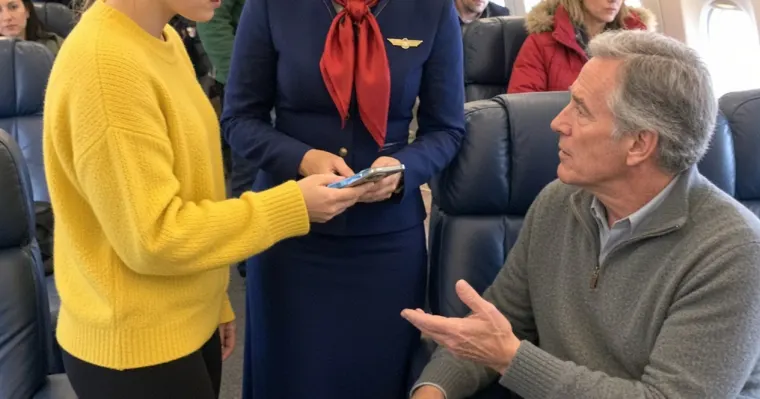
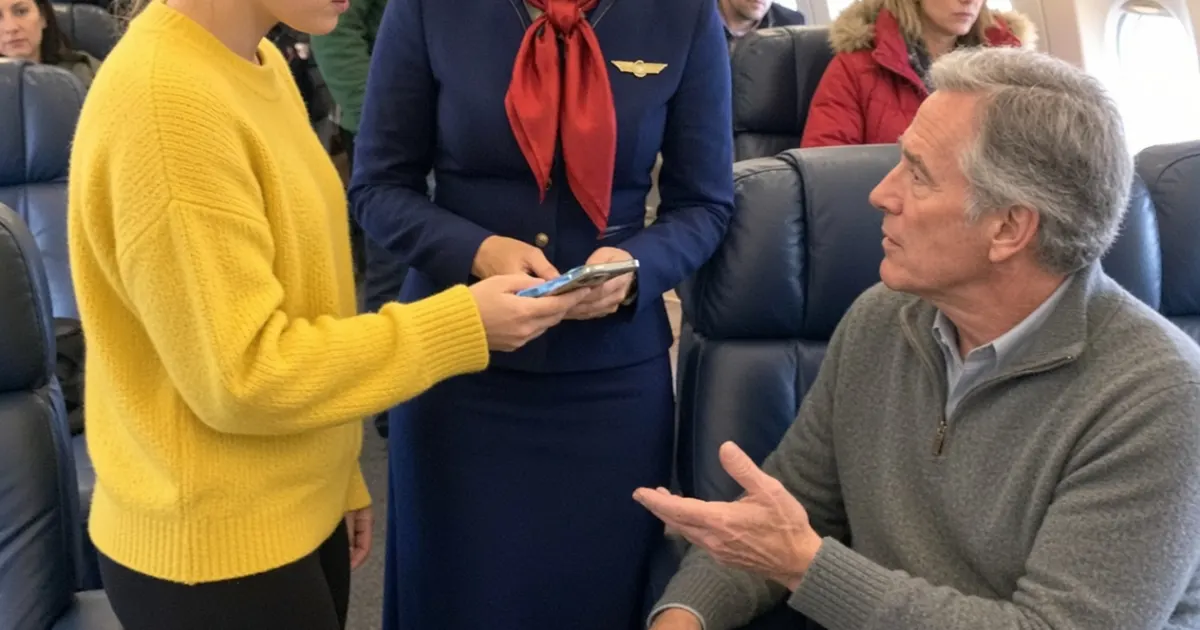
When I stepped into the First Class cabin, I checked my boarding pass one more time, even though I had checked it nine times already. Seat 3A. Window. Exactly where I was supposed to be. But there was already someone in it. He was a tall man in his early sixties, silver-haired and tanned, wearing a charcoal suit that looked like it cost more than my father’s car, with gold cuff links and a heavy watch. He had settled comfortably into the seat by the window, his legs crossed, reading the Wall Street Journal with a glass of champagne on the armrest. I walked up to the row and waited until he turned a page. Then I said, politely, excuse me, sir, I think you might be in my seat. He glanced up at me for about half a second. Then he went back to his newspaper and told me that Economy was toward the back, young lady. I blinked. I told him I was actually assigned to 3A. He lowered the paper a few inches and looked at me properly for the first time. His eyes moved over my grandmother’s oversized sweater, my old sneakers, my little canvas bag. And I watched him decide who I was. He said that then somebody had made a mistake. I looked at my boarding pass again. Everything was right. I asked him, as nicely as I knew how, if he would mind checking his own ticket. He slowly folded his newspaper and set it on his lap. He asked me if I knew who I was talking to. I said no, sir. He told me his name was Conrad Ashby, and that he was the president of Ashby Capital Group. He said it the way some people say the name of a famous team, as though it should mean something. Then he waited. I simply nodded and told him it was nice to meet him, but that my boarding pass still said 3A. A couple in Row 2 turned around in their seats to look at us. A man across the aisle lowered his laptop.
Conrad Ashby’s face darkened. He asked me if I was seriously going to argue with him over a window. I told him I wasn’t arguing; I was just trying to find my assigned seat. A senior flight attendant came up the aisle then, a woman in her fifties with short gray hair and a name tag that read CLAUDETTE. She asked if there was anything she could help with. Conrad answered before I could open my mouth. He said that this girl didn’t understand where she was supposed to sit. I handed Claudette my boarding pass. She read it, then looked at me and said, Miss Caldwell, you are assigned to Seat 3A. Then she asked Conrad for his boarding pass and checked it. She told him, very politely, that his assigned seat was 3B, the aisle seat right beside it, and asked if he would please move over. Conrad folded his arms. He asked what the difference was, since both seats were in First Class. Claudette said the window seat was assigned to Miss Caldwell. He said, loudly, that he had paid a fortune for this flight. Claudette stayed perfectly calm. She told him both passengers had confirmed reservations. And then Conrad said, in a voice that carried through the entire front cabin, that he was not moving for a child. Nobody spoke. A woman in Row 1 shifted uncomfortably. I felt my face get hot, and I wanted very badly to disappear, but I made myself stand up straight in my grandmother’s sweater and not let him see it. Then he turned and looked straight at me, and said I ought to be grateful I was even allowed to sit up here. For a moment, I couldn’t find a single word. I wasn’t used to being judged like that, for my age, for my clothes. I thought about my grandmother, who had spent forty years in this cabin being polite to men exactly like him, smiling and pouring their champagne and never once letting them see when they hurt her. And I thought about my father, who would not want me to have a shouting match with a stranger at the front of a plane. So I took a deep breath. I told Conrad Ashby that it was okay, that he could stay there.
Claudette shook her head and said, sweetheart, you are entitled to your seat. I told her I understood, and I thanked her. Conrad smiled, satisfied, and said that finally someone had made a sensible decision. I looked at him for a long moment. Then I told him to have a pleasant flight, and I picked up my canvas bag, very carefully, and walked toward the forward galley. Claudette followed me. She asked if I was all right. I said I was, and asked if I could make a phone call before we took off. She said of course. I took out my phone. In my contacts, my father was saved under a special label he had set up himself the day I got my first phone, a label that went to a line he answered no matter what meeting he was in or what time zone he was in: DAD: OPERATIONS. I pressed it. He answered on the first ring. He said my name and asked if everything was okay. I told him not exactly. He asked what happened. I told him someone was sitting in my assigned seat and wouldn’t move. He asked which seat. I told him 3A. He went quiet for a second; he knew exactly why that seat mattered. He asked if a crew member had verified both reservations, and I told him yes, and that the man was assigned to 3B. He asked me if I was somewhere safe. I said I was standing in the galley with a flight attendant. He asked if the man had threatened me in any way. I said no, he had just told me I didn’t belong in First Class. There was a long silence on the other end of the line. Then my father asked me for the flight number. I told him, 467, Boston to Dublin. Claudette had been standing beside me, and when she heard my last name clearly, her eyes went to my face. She leaned in and whispered, excuse me, is your father Desmond Caldwell? I nodded. Her eyes widened. My father was the senior vice president responsible for international operational partnerships across North Star’s entire alliance network. He had spent twenty years working alongside airline management, overseeing complex safety and operations arrangements on three continents. But I almost never talked about his job. I didn’t want anyone treating me differently because of it.
My father’s voice came back on the line, calm and level as always. He asked me if the crew had instructed the man to move. I said yes. He asked if the man had refused. I said yes. I looked back down the aisle toward Row 3. Conrad Ashby had picked his newspaper back up and was reading it with his champagne, perfectly content. I brought the phone close to my mouth and said, quietly, Dad, shut it down. Almost immediately, the gate agent’s tablet on the jet bridge chimed. She looked down at it, read something, and then looked up sharply toward the open cabin door and called out to hold boarding. On the tarmac, the ground crew stopped loading bags. Passengers in the aisle looked around at each other, confused. The aircraft door stayed open. In Row 3, Conrad lowered his newspaper a few inches and asked why they weren’t leaving. Nobody answered him. Then there were footsteps on the jet bridge, and two men stepped into the cabin: a Massachusetts State Police airport officer in uniform, and a tall man in a navy blazer with a North Star operations lanyard, holding a red folder. Across the front of the folder, in heavy black letters, was printed FLIGHT 467: IMMEDIATE HOLD. Claudette stepped forward to meet them. The supervisor said he needed to speak with Miss Nia Caldwell. I raised my hand from the galley and said that was me. His face softened, and he asked if I was all right. I told him I was, thank you. He looked at my boarding pass, then down the aisle at Seat 3A. Conrad was watching now, his newspaper forgotten in his lap. He demanded to know what was going on. The supervisor walked to Row 3 and said they had received a report about the seating in this cabin. Conrad said I had made a ridiculous complaint and that he hadn’t done anything wrong. The supervisor asked if his reservation was for 3B. Conrad hesitated and said yes, but. The supervisor asked if he had been instructed to move there. Conrad said yes, but it was practically the same seat. The supervisor asked him why, then, he had refused the crew’s instruction. And for the first time since I had met him, Conrad Ashby had no answer. Finally, he pointed at me and said that I was just a teenager. The supervisor said, evenly, that my age had nothing to do with the validity of my reservation. The cabin fell silent. Conrad looked around and realized everyone was watching. He asked why security was there, that this was completely unnecessary. The supervisor opened the red folder and said the flight was being held while an operational concern was reviewed. Conrad drew himself up and asked if the man had any idea who he was. The supervisor looked up and said yes, sir, his identity was on the passenger manifest. Somebody in Row 1 laughed quietly. Conrad’s face turned red. He said he had important meetings in Dublin. The supervisor said then he suggested they resolve this professionally. Conrad glanced back at me, uneasy now, and asked who exactly this girl was. The supervisor didn’t answer. He turned another page and asked Claudette to confirm that she had verified my boarding pass and that Mr. Ashby had declined to move. She said yes, she had personally verified both. The supervisor nodded, then looked directly at Conrad and said there was something else they needed to discuss before the aircraft could depart. Conrad’s confidence drained from his face. He asked what something else. The supervisor laid the red folder on the empty seat beside him. I stood quietly in the galley holding my phone. I hadn’t raised my voice. I hadn’t threatened anyone. I had only refused to let a stranger convince me that I didn’t deserve what I had rightfully paid for. And now the man who had dismissed me because I was fifteen was finally listening. But when the supervisor turned to the next page of the report, Conrad suddenly realized the situation involved much more than a disagreement over Seat 3A.
THE STORY CONTINUES ON THE NEXT PAGE… 👇👇👇
This article is general information, not personal medical or financial advice. Talk to a qualified professional about your own situation.