A Rich Businessman Took My First Class Window Seat And Told Me I Belonged In Economy Because I Was Fifteen, So I Politely Let Him Keep It And Made One Quiet Phone Call Before Takeoff
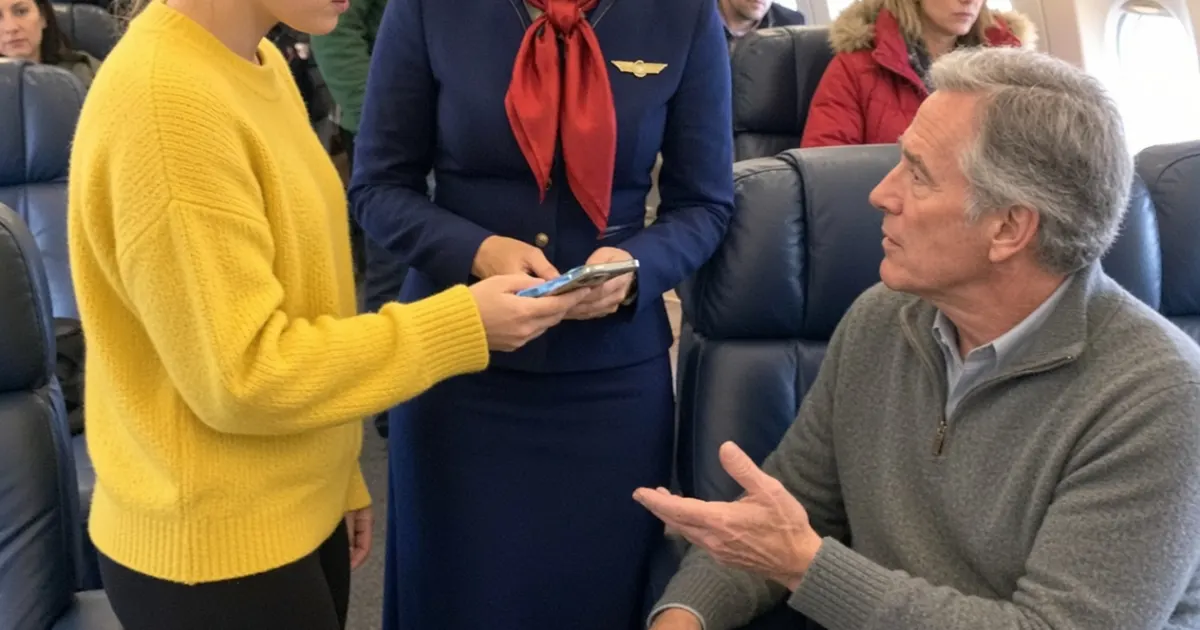
The supervisor’s name was Owen Fitzgerald, and he read from the folder in a level, unhurried voice, loud enough for Conrad to hear but not for the whole cabin. He explained first, so there would be no misunderstanding, that my father had not asked for anything special. My father had done exactly what any passenger’s parent could do: he had contacted the airline’s operations control center to report that a crew instruction had been refused on a flight carrying an unaccompanied minor. Under North Star’s policy and federal aviation regulations, Mr. Fitzgerald said, a passenger who refuses a crew member’s instruction before departure is considered to be interfering with crew duties, and the aircraft does not push back until that is resolved. He said the hold would have happened the same way if any parent had called, or if the captain had been told. My father had simply known which number to call. Then Mr. Fitzgerald turned to the second page. He said that Miss Caldwell was traveling in the airline’s unaccompanied minor program, and that her seat had been assigned in coordination with the crew, in the forward cabin near the galley, as the program requires. He said that Miss Caldwell was also carrying, with full documentation approved by the airline and by Irish customs, the cremated remains of a family member, which required that she and her carry-on remain in her assigned seat for the duration of the flight. He looked up from the page. He said the family member was Maeve Caldwell, who had served as a North Star flight attendant on this route for forty years. He said that Seat 3A had been requested specifically, months in advance, so that Miss Caldwell could see the coast of County Kerry at dawn, the way her grandmother had asked her to in her will. Conrad Ashby’s face went slack. He looked from Mr. Fitzgerald to the canvas bag in my hand, and then to my grandmother’s sweater, and I watched something in his expression break open.
Mr. Fitzgerald turned one more page. He said, more quietly now, that there was one last matter. He said that North Star’s customer records showed two previous formal reports involving Mr. Ashby, both filed by flight crew within the past eighteen months, both for verbally abusive behavior toward cabin staff, both resulting in written warnings under the airline’s passenger conduct policy. He said that under that policy, a third documented incident of refusing crew instructions could result in Mr. Ashby being denied boarding, and that the decision rested with the captain. He closed the folder. The cabin was so quiet I could hear the hum of the auxiliary power unit somewhere beneath the floor. Then the cockpit door opened, and the captain stepped out, a woman in her late forties with her hair pulled back and four gold stripes on her sleeves. Her name was Captain Siobhan Reilly. She looked at Conrad for a long moment. Then she looked at me. And then she asked me, gently, what I would like to happen. Every head in the cabin turned toward me. I could feel Conrad looking at me too, and for the first time all afternoon, he looked afraid. I thought about it. I thought about my grandmother pouring champagne for forty years for men who never learned her name. I thought about what she would have said. And then I told the captain that I didn’t want anyone removed from the flight. I said I only wanted my seat. Captain Reilly nodded slowly. She turned to Conrad and told him that he had two choices. He could move to his assigned seat, 3B, and fly to Dublin quietly and respectfully. Or he could take his bag and leave the aircraft now, and the airline would rebook him on tomorrow’s flight. Conrad stood up. He didn’t say anything for a few seconds. Then he picked up his newspaper and his champagne glass and stepped out into the aisle. He moved over into Seat 3B and sat down. Then he looked up at me, and in a voice so low that only I could hear it, he said he was sorry. It didn’t sound like something he said very often.
I sat down in Seat 3A, finally, and placed the canvas bag carefully under the seat in front of me, with one foot resting gently against it. The officer and Mr. Fitzgerald walked off the plane. The door closed. Fourteen minutes after the hold began, Flight 467 pushed back from the gate. For the first hour, Conrad Ashby didn’t say a word. He sat stiffly in 3B with his newspaper open and didn’t turn a single page. Claudette brought me a cup of hot chocolate with extra whipped cream, unasked, and winked at me. Somewhere over Nova Scotia, while the cabin lights were dimmed for the night, Conrad finally set the newspaper down and asked me, quietly, about my grandmother. I almost didn’t answer. But then I told him. I told him about the stone cottage outside Dingle, and the one suitcase, and the forty years of transatlantic flights. I told him how she used to describe the coast of Kerry at dawn, out the left side window, so vividly that I could see it with my eyes closed. I told him she had darned the elbow of this sweater herself after catching it on a galley cart. He listened without interrupting. When I finished, he was quiet for a long time. Then he told me something I didn’t expect. He said his own mother had cleaned offices at night in Hartford for twenty-six years so that he could go to college, and that she had worn the same gray cardigan to work every single night until the elbows wore through. He said that he had spent his whole adult life trying to get as far away from that cardigan as possible, and that somewhere along the way, he had started looking at anyone in plain clothes the way people used to look at his mother. He said he had just realized it, sitting there, after forty years. He said he was ashamed. I didn’t know what to say to that. So I offered him half of the shortbread Claudette had brought me. He took it.
The sun came up a little after six in the morning, Irish time. I had set an alarm, but I didn’t need it. I had been awake, watching the dark window, for an hour. At first there was nothing, only gray cloud and gray sea. And then the plane began to descend, and the clouds thinned and tore open, and suddenly, out the left side window, exactly where my grandmother had always said it would be, there it was. The coast of Kerry. Green, impossibly green, the green of every story she had ever told me, with jagged black cliffs dropping straight into the white foam of the Atlantic, and a white lighthouse on a headland, and tiny white houses scattered across the hills like sugar cubes, all of it glowing in the low gold light of the sunrise. I pressed my hand flat against the window. And I cried, just the way she said she did, every single time, for forty years. Beside me, Conrad Ashby leaned over very slightly to look past me through the glass. He didn’t say anything. He didn’t need to. Claudette came and knelt in the aisle beside my seat and looked out too, and she told me she had flown with my grandmother on this route in 1997, as a brand-new flight attendant, and that Maeve had made her come to this exact window on her very first trip and look at this exact view. She said my grandmother told her that if she ever stopped crying at it, it was time to retire. We landed in Dublin at 6:42. As we were getting off the plane, Conrad stopped in the jet bridge and handed me one of his business cards. On the back, he had written something in pen. He said that he was sorry he had made me feel small on a day that was supposed to be about someone so much bigger than him. Then he walked away into the terminal and disappeared into the crowd.
My father flew in that evening to join me, as we had planned, and two days later, the two of us drove west across Ireland to Dingle. We found the stone cottage where my grandmother was born, still standing at the end of a narrow lane above the harbor, with a red door and a fuchsia hedge. A farmer named Padraig, who turned out to be my grandmother’s second cousin, walked us up the hill behind it to a place she had told him about decades before, where you could see the whole bay and the open Atlantic beyond it. I opened the small wooden box there in the wind and let her go, and the ashes caught the light and blew out over the green fields toward the sea she had flown over ten thousand times. My father held my hand the whole time and didn’t say anything, which was exactly right. That December, a letter arrived at our house in Boston, addressed to me. It was from Conrad Ashby. Inside was a short note and a copy of a document. The note said that he had spent a long time thinking about our flight, and about his mother’s gray cardigan, and about my grandmother’s sweater. The document was the founding paperwork for a scholarship fund, endowed with five hundred thousand dollars, for the children of airline cabin crew who wanted to go to college. It was called the Maeve Caldwell Scholarship. In the note, he asked my permission to use her name. My father read it twice and handed it back to me and told me it was my decision. I wrote back and told Mr. Ashby yes. I still wear my grandmother’s sweater, darned elbow and all, every time I fly. A man once looked at it and decided I didn’t belong where I was sitting, and on that flight I learned that you never have to raise your voice to claim the place you’ve earned; you only have to stop agreeing to disappear from it.
This article is general information, not personal medical or financial advice. Talk to a qualified professional about your own situation.