I Had a 104-Degree Fever for 7 Days Then the ER Doctor Saw My Ankle and Called the Police
I told her everything, or as much as I could manage through the fever and the exhaustion — the fall on the stairs, the week of “tomorrow,” the ointment Luca kept applying, the way he always asked me to look away or close my eyes while he worked, the way every single request to see a doctor had been met with calm, confident reassurance that just cost me one more day of waiting.
Detective Hall listened without interrupting, taking careful notes, her expression giving away very little until I mentioned, almost as an afterthought, that we had a security camera in the garage.
“Does it still work?” she asked.
“Luca told me it broke months ago,” I said. “He said he never got around to fixing it.”
Something shifted in her expression at that, subtle but unmistakable, and she excused herself to make a phone call.
Also readAt the Family BBQ, Dad Joked, “Pay Rent or Get Out.” The Next Day, I Moved Into My New House — and They Finally Realized Who Paid for Theirs.Dr. Marcus returned before I could ask what would happen next. He had the laboratory results from the dressing residue.
“The material on the gauze is consistent with a highly caustic alkaline cleaner,” he said. “It can cause severe chemical burns and tissue damage. Combined with an existing wound, repeated exposure could make the injury significantly worse.”
My throat tightened.
“Did he cause the fever?”
Dr. Marcus chose his words carefully. “Your fever and the condition of your leg suggest a serious infection or inflammatory response. We are treating that aggressively. But the laboratory result gives us a separate concern: repeated chemical exposure to the wound.”
I looked at the dressing in the specimen bag. The thing Luca had called antiseptic had been damaging me. And he had been the person applying it.
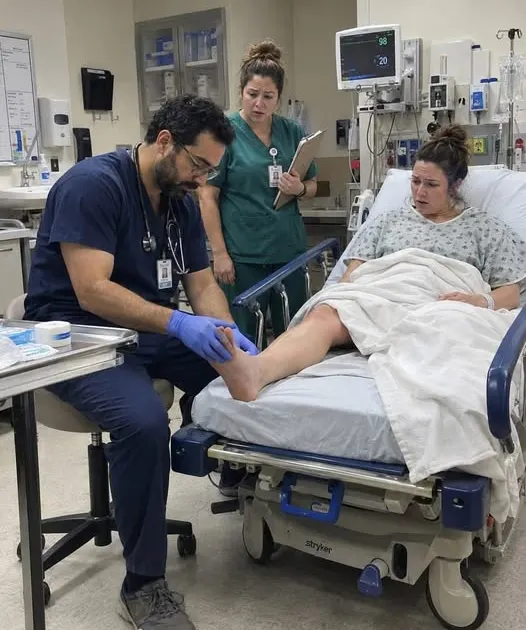
A nurse adjusted my IV while another physician came in to examine the discoloration around my ankle. They marked the edges of the affected area so they could monitor whether the damage was spreading. For the first time in a week, people were watching my condition instead of asking me to wait until tomorrow.
Detective Hall stepped into the hallway to speak with the officers downstairs. A few minutes later, she came back.
“Luca is still demanding to see you,” she said.
My stomach dropped. “What is he saying?”
“That you’re confused because of the fever. That he was taking care of you. That you left without telling him and he was worried.”
I almost laughed. Not because anything was funny. Because I had spent seven days listening to exactly that version of my own reality. I was confused. I was overreacting. I was making the wound worse by touching it. I needed to wait.
I looked down at my swollen ankle. “Can he come here?”
“No.” The answer was immediate.
Detective Hall showed me another photograph from the security recording. “Before we do anything else, I want you to tell me whether this cabinet is normally locked.”
I stared at the image. It was the metal cabinet in the garage that Luca had always called his cleaning cabinet. I had never paid attention to what was inside it.
“I don’t know,” I said. “He keeps the garage organized. I never go through his things.”
“That’s okay.” She didn’t pressure me. “Do you know why he might have had a bottle of industrial cleaner in there?”
“No.”
“Did you ever see him use it around the house?”
“No.”
“Did he ever tell you to stay away from the cabinet?”
I thought about it. “Once. A long time ago. He said some of the chemicals were dangerous.”
Detective Hall wrote that down. Then she asked the question that hurt more than the others.
“When did he first tell you the scrape was getting worse?”
“The second day.”
“And when did he first change the dressing himself?”
“That same night.”
The detective looked at me. “Did he ever encourage you to see a doctor?”
I shook my head. “He kept saying tomorrow.”
She nodded once. “And every time you wanted to look at the wound?”
“He told me not to touch the tape.”
The room became very quiet.
I suddenly understood why the words on his text had frightened everyone so much. Don’t tell them about what I put on your leg. It wasn’t just that he had known what he had put there. It was that I had never told him the doctor was asking. He had preemptively anticipated a conversation I hadn’t even had yet, which meant he had been watching, somehow, for exactly this moment, prepared with a message ready to send the instant he suspected the truth might surface.
Detective Hall placed my phone back on the bedside table after photographing the messages. “You did the right thing by leaving.”
I closed my eyes. I hadn’t felt brave when I ordered the cab. I had felt terrified. I had been holding the wall because I could barely walk. I had been afraid that if Luca caught me leaving, he would make me stay.
But now, lying under the hospital lights with an IV in my arm, I realized something else. For the first time in seven days, I had made a decision without asking him whether I was allowed to make it.
A nurse came in to tell me that the doctors were preparing additional treatment for the infection and the chemical injury. The next several hours would be important, and they wanted to keep me under close observation.
I nodded. Then my phone vibrated again.
Detective Hall looked at the screen without touching it. Another message from Luca.
I KNOW YOU’RE WITH THE POLICE.
A second message followed.
YOU’RE MAKING A HUGE MISTAKE.
Then another.
I WAS TRYING TO HELP YOU.
I stared at those words. They were almost identical to the sentence I had repeated earlier. He said he was helping me. For seven days, that sentence had protected him. Now it was becoming evidence against him.
Detective Hall asked me not to respond. She stepped outside and spoke with the officers again. A few minutes later, one of them returned with a small evidence bag.
Inside was a bottle recovered from the garage. The label was partially visible. I recognized it immediately. It was the bottle Luca had always told me was too strong for ordinary household use.
The officer placed another item beside it. His phone.
Detective Hall explained that they had secured the relevant devices and would seek the appropriate authorization to examine the contents.
I didn’t ask what they expected to find. I was beginning to understand that the truth was no longer something I needed to force into existence. It was already there. The camera had captured it. The dressing had preserved it. His messages had confirmed it. And the wound on my ankle had been telling me for days that something was terribly wrong.
The hardest part was admitting that I had trusted the wrong person with the one thing I could not afford to lose: my ability to know what was happening to my own body.
That night, Luca had told me to leave the tape alone. I had finally done the opposite. I had pulled it back. And everything changed.
Over the next day, the doctors continued treating me while monitoring the damaged tissue and the infection. The fever finally began to come down. It didn’t happen all at once. It happened by degrees, slowly enough that I was afraid to celebrate.
But the number on the monitor changed. A hundred and three. Then a hundred and one. Then below a hundred. For the first time in a week, I woke without feeling as if my entire body were burning.
I want to describe that particular morning, because it stayed with me afterward in a way few things ever have. Sunlight was coming through the hospital blinds in narrow, dusty stripes across the blanket, and a nurse I hadn’t met before came in to check my vitals, humming something under her breath while she worked, entirely unbothered, entirely ordinary. I remember lying there and feeling, for the first time in seven days, like an ordinary patient recovering from an ordinary injury, rather than a person quietly negotiating for permission to exist inside her own crisis.
My sister, Delphine, arrived that afternoon, having driven three hours after Detective Hall’s office reached her as my emergency contact. I hadn’t spoken to Delphine in nearly two months, a distance I understood, looking back, as another small casualty of the particular shape my marriage had taken over the years — not any dramatic estrangement, just a slow, quiet erosion of the relationships that existed outside Luca’s orbit. She sat beside my hospital bed and cried before she’d even fully sat down, and I found myself, oddly, comforting her rather than the other way around, some old habit of managing other people’s feelings even in the middle of my own crisis refusing to fully let go.
“Why didn’t you call me?” she asked, once she’d composed herself enough to speak clearly. “Any of those seven days. Why didn’t you just call me?”
I didn’t have a clean answer for her, not one that made sense outside the particular fog of that week. I told her, as honestly as I could manage, that it hadn’t occurred to me, not really, not as a live option sitting right there the whole time. Luca had positioned himself, over years, as the person who handled things. Calling my sister to second-guess him would have felt, in the moment, like an accusation I had no evidence to support. It was only once the evidence existed independently of my own judgment — the camera footage, the lab results, the texts — that I fully understood how thoroughly that instinct had been shaped, patiently, over a long time, rather than arriving naturally on its own.
Detective Hall came to see me that afternoon. She told me the investigation was continuing and that the recordings had been preserved. She also told me that the evidence from the dressing, the bottle, the messages, and the home security system would all be evaluated together.
She didn’t promise me a particular outcome. She didn’t need to. She had already given me something I had been missing for seven days.
She believed what I was saying.
Before she left, she asked whether I wanted to speak with Luca.
I looked at my phone. There were dozens of missed calls.
I shook my head. “No.”
It was the easiest answer I had given all week.
In the days that followed, while I remained hospitalized for continued treatment, Detective Hall returned twice more, each time with additional pieces of the picture that had, by then, come fully into focus. The forensic examination of the recovered bottle confirmed what the lab had already suggested from the dressing residue — an industrial-strength alkaline cleaner, the kind used in commercial settings for stripping heavy grime, entirely unsuitable and genuinely dangerous for use on human skin, let alone an open wound. It had been sitting in Luca’s garage cabinet as part of the sample inventory from his sales job, product he wasn’t even authorized to keep in a residential setting according to his own company’s safety protocols, something Detective Hall discovered when she contacted his employer as part of the investigation.
The full review of the security footage, once investigators had gone through all seven nights in sequence, showed a consistent pattern that made my skin crawl each time Detective Hall walked me through another piece of it. Every single night, without exception, Luca had gone to that cabinet before attending to my wound. Every single night, he had returned the bottle to the same shelf afterward, careful, methodical, the same practiced motions each time. It wasn’t panic. It wasn’t a single catastrophic mistake made under pressure. It was a routine, repeated deliberately across an entire week, while he simultaneously discouraged me from examining the wound myself and delayed, night after night, any actual medical attention.
The sixth-night footage, the one where he’d checked his phone in the garage doorway before returning to the house, turned out to matter more than I initially understood. The message thread visible on his screen, once investigators obtained proper authorization to examine his phone directly, was with a woman named Priya, someone I’d never once heard Luca mention in six years of marriage. Their exchange that night, and in the messages leading up to it, revealed something that reframed the entire seven days for me in a way I genuinely wasn’t prepared for.
Luca had been planning to leave the marriage. Not abruptly, not violently — nothing in the messages suggested any coherent plan involving harm to me specifically. But the messages, taken together, painted a portrait of a man who had checked out of our marriage months before I scraped my heel on those basement stairs, who had been quietly building a separate life with Priya, who had apparently found my sudden, inconvenient medical crisis to be exactly that — inconvenient, an obstacle standing between him and whatever exit he’d been slowly, carefully constructing.
I don’t believe, even now, that Luca deliberately poured caustic cleaner on my wound intending to seriously harm me. The psychologist I eventually spoke with, months into my recovery, offered a version of events that felt, uncomfortably, closer to the truth than any more dramatic explanation might have: a man under considerable, compartmentalized stress, distracted by an affair he was actively managing, treating my medical crisis with the same detached, overconfident competence he brought to every other problem in his life, reaching for whatever bottle was closest at hand in a garage cabinet organized more around convenience than caution, genuinely believing, in some limited, self-serving way, that he was handling it. The delay, the discouragement from seeking real medical care, the repeated tomorrow — that part, investigators and I both came to believe, was less about deliberate cruelty and more about Luca’s overriding need to keep control of a situation that was rapidly slipping past his ability to manage it, and his unwillingness to admit, even to himself, that he’d made a serious mistake days earlier that had already begun causing real damage.
None of that made it less dangerous. If anything, understanding the ordinary, almost banal selfishness underneath it made it harder to sit with, not easier. It would have been simpler, in some ways, to have a villain instead of a man who had simply prioritized his own convenience and his own image of competence over my actual safety, seven nights running, while telling himself and me the same reassuring story each time.
Luca was arrested nine days after I left in that cab, following the completion of the forensic review and a formal review by the district attorney’s office. He was charged with reckless endangerment and, once the full timeline of the industrial cleaner exposure was established, with a more serious charge related to the deliberate delay of medical care for a dependent adult, a charge whose exact legal language I still find myself reading over occasionally, months later, trying to fully absorb what it meant that a stranger in a government office had needed a specific statute to describe what had happened to me in my own kitchen.
The criminal case took the better part of a year to resolve. I won’t detail every step of it here, except to say that the security footage, preserved intact from a camera Luca had told me for months was simply broken, became the single most important piece of evidence in the entire proceeding. He had apparently disabled the live feed to his phone at some point, believing that meant the system had stopped recording entirely. It hadn’t. The local storage drive in the garage had kept every frame, silently, for months, waiting for someone to finally ask the right question.
I moved out of our house within three weeks of my discharge from the hospital, staying with Delphine while my ankle finished healing and while I began the slower, less visible work of figuring out who I was outside a marriage that had, I came to understand gradually, been quietly reshaping my instincts for years before that particular week ever forced the pattern into the light. Physical therapy for the ankle took nearly four months; the tissue damage from the chemical exposure, layered on top of the infection, left scarring that I’m told will fade further over time but will likely never disappear completely. I’ve come to think of it, somewhat deliberately, as a kind of record of my own — the body’s version of the security footage, evidence that doesn’t require anyone’s belief to remain true.
Several weeks later, I still remembered the exact moment Dr. Marcus lifted the dressing and froze.
At the time, I thought the most frightening thing was that something was wrong with my ankle.
I was wrong.
The frightening part was discovering that the person standing closest to me had been controlling what I was allowed to see.
I had spent seven days believing tomorrow would bring the care I needed. It was a stranger in a cab, a triage nurse, a doctor, and a detective who finally brought me into the present.
And there was one lesson I couldn’t forget.
When your body is telling you something is wrong, you don’t need someone else’s permission to listen.
I had waited for tomorrow because my husband told me to.
I survived because, on the seventh day, I stopped waiting.
This article is general information, not personal medical or financial advice. Talk to a qualified professional about your own situation.