The Night Before My Son’s Wedding His Fiancée Pulled Me Into A Quiet Hallway And Told Me The Greatest Gift I Could Give Was To Disappear, So I Went Home And Started Making Plans
My name is Carolyn Marsh. I spent twenty-eight years on the family court bench in Gallatin County, Montana, and in that time I presided over eleven hundred and forty-two cases involving the dissolution of marriages, the division of property, and the protection of children from the people who were supposed to protect them. I am not a sentimental woman, by habit. The job trains it out of you. You learn to listen for what people leave out rather than what they say, to watch the hands rather than the face, to read a financial disclosure the way other people read a novel, looking for the plot hiding between the lines. I retired at sixty-seven, the year after my husband, Robert, died of a stroke in his workshop. We had been married forty-one years. Robert was a civil engineer who had spent his career designing bridges, but what he truly loved was building things with his hands, things that were meant to outlast him.
He spent four years building our house outside Bozeman, up on a hillside with a view of the Bridger Range and the valley below. He poured the foundation himself and framed every wall and laid the white oak floors by hand, and when he finished, he walked through every room touching the doorframes and said, well, it’s not perfect, but it’ll stand. He was right on both counts. It was not perfect in the way that made it human, with a kitchen window that stuck in cold weather and a porch step that creaked on the left side, and it would stand long after everyone who had ever walked its floors was gone. I had lived in it for thirty-six years. I had planned to die in it, and I had planned, quietly and without ceremony, to leave it to our son.
Ethan Marsh was thirty-three years old when he brought Paige Calloway home for the first time. He was a structural engineer, like his father, and he had his father’s quiet manner and his father’s tendency to assume that people were trustworthy until they proved otherwise. I had tried to teach him, with limited success, that this was an admirable quality in a friend but a liability in a negotiation. Paige was thirty-one, and she was beautiful in the way that some women are beautiful, the kind of beauty that is carefully managed and deployed, that arrives in a room slightly ahead of the person wearing it. She worked in real estate marketing. She had a gift for entering a space and understanding its value before she understood its story. The first night she came to dinner, she complimented the kitchen light fixture and asked about the square footage before she asked about the photographs on the wall. I noticed. I told myself I was being uncharitable. Judges, especially retired ones, have an occupational hazard of reading too much into insufficient evidence. I tried to extend the benefit of the doubt.
I tried for eight months. Then her brother, Nolan, showed up unannounced on a Saturday in October, three months before the wedding, while Ethan was at a job site. He said he was in the neighborhood and wanted to say hello. He knocked on walls in the hallway. He went down into the crawlspace to look at the foundation without asking. He stood in the kitchen and said the house had great bones and that the layout was really functional. He asked about the year of the roof. I answered his questions pleasantly and showed him out and stood at the front window and watched his truck go down the driveway and thought about the word deployment. That was a Thursday. On the following Monday, I called my attorney, a careful woman named Ruth Ostrowski who had handled my estate work for fifteen years, and I told her to begin drawing up a document, but not to execute anything until I told her to.
The wedding was planned for a Saturday in June, at a vineyard east of Bozeman. It was a beautiful setting and an expensive one. The catering, the flowers, the ceremony rental, and the reception were being paid entirely by me, a total of eighty-four thousand dollars, because Paige’s parents were on a fixed income and Ethan’s salary as a structural engineer was solid but not extravagant and they had asked me, together, over dinner, the previous winter, and I had said yes, because he was my son and I had the resources and because Robert would have wanted him to have a beautiful wedding and because, I told myself, I believed in this marriage. The deed to the house had been sitting in a manila envelope in my desk drawer since February. I had been going back and forth about how to present it. I wanted it to be meaningful, not transactional. I thought perhaps at the rehearsal dinner, after the toasts, I would take Ethan aside and hand it to him and tell him that his father and I had always meant for him to have it. I had not told Ethan it was coming. I certainly had not told Paige. The rehearsal dinner was on a Friday evening at the winery, the night before the ceremony. I arrived early. I was seated at table nine, beside the emergency exit near the restrooms, in spite of being the mother of the groom and the person whose credit card had reserved the entire venue. I noticed this, but I told myself it was a seating chart error and let it go. I had the manila envelope inside my blazer, against my ribs, the way I used to carry important documents during particularly contentious proceedings when I didn’t want opposing counsel to see them too early.
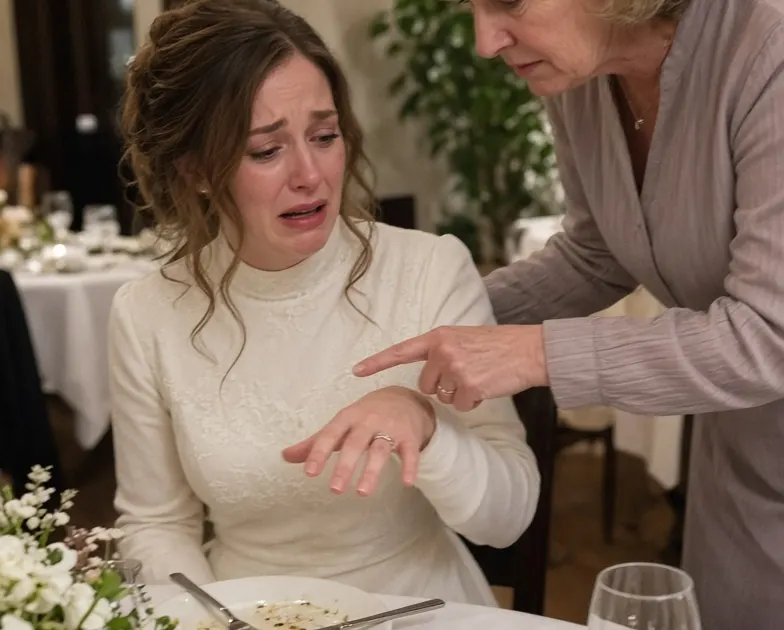
Also readWhy Public Bathroom Stall Doors Don’t Reach the Floor—and the Reasons Are More Practical Than You ThinkThe evening went on. The toasts were given. Dessert was served. I was waiting for a natural moment to pull Ethan aside. And then Paige appeared at my elbow and said she needed a quick word, and steered me into the carpeted corridor that led to the restrooms, away from the music and the guests. She stood facing me in that corridor with her hands clasped in front of her and her face arranged into something between composure and resolution, the way people look when they have rehearsed what they are about to say. She was wearing a cream-colored dress and her hair was pinned up and she looked beautiful and she looked like a stranger. She said, in a measured voice that carried no heat at all, which was somehow the worst part, that the greatest gift I could give them was if I disappeared from this family. She said Ethan didn’t need me anymore. She said he had her. I looked down at the inside of my blazer. I could feel the envelope against my ribs. I didn’t take it out. I slid it back into the inside pocket and told her I had heard her, and I turned and walked back through the lobby and collected my coat and went to my car and drove home across Bozeman in the dark. I sat in Robert’s workshop until two in the morning, under the fluorescent light that buzzed slightly, the way it had always buzzed, sitting at the workbench he had spent an entire Saturday leveling so it was exactly right. I unfolded the deed on that workbench and smoothed it out, and I looked at the signature line for a long time. And then I picked up a pen and I wrote one word across it, in my clearest handwriting, the handwriting I used to sign judicial orders: Denied. Then I folded it back up and put it in my pocket and went to bed.
The next morning, I did not go to the wedding. Ethan called six times. The first call, I let ring. The second, I answered and told him I was not well and would not be able to attend. He asked about his father’s wedding ring, which I had been holding for him, intending to give it to him at the ceremony so he could carry something of Robert’s into his marriage. I told him I would hold it for now. He asked if I was all right. He did not ask what had happened. He did not ask what Paige had said to me in that corridor. I didn’t expect him to. He didn’t know. And then I hung up and I sat with the fact that my son had married a woman who had told me to disappear, and that I had spent eighty-four thousand dollars making her wedding beautiful, and that the house Robert had built with his hands and his years was sitting on a hillside outside Bozeman waiting to be signed over to people who had already calculated what they would get for it. Three days after the wedding, Paige called me. I let it ring twice before I answered. The apology, if it could be called that, lasted fourteen seconds.
It was a performance, and not a particularly good one, and when it was over, she asked me what the special gift was that Ethan had mentioned, the gift I had been planning to give them. I told her I would need to think about that and ended the call. That afternoon, I found an envelope in my mailbox that had been misdirected by the mail carrier, addressed to our street but the wrong number. Inside was a property market analysis, bound and tabbed, with photographs of every room in my house on its cover. Every room Robert had built. The photographs were professional. The client on the cover sheet was listed as P. Calloway. Paige. The report had been prepared four months before the wedding, the same month Nolan had appeared in my doorway to knock on my walls and ask about the roof. In the margins, in a hand I did not recognize but suspected was Nolan’s, renovation costs had been written in pencil beside the kitchen, the bathrooms, the floors. And at the bottom of the last page, in the same hand, was a projected sale price and a projected profit after renovation, and underneath that, a figure that represented the difference between what they would put into it and what they expected to take out
I sat at Robert’s workbench and read that document from cover to cover, three times, the way I used to read a contested filing before a hearing. I looked at the dates. The market analysis had been commissioned in February, the same week I had asked Ruth Ostrowski to begin drafting the deed documentation but not to execute it. Which meant Paige had been planning this before she knew anything about the deed. She hadn’t targeted my house because she knew it was coming. She had targeted it because she had priced it. I called Ruth on Monday morning and told her to execute the transfer, but not to Ethan, and not jointly. I told her to transfer the property into the Carolyn Anne Marsh Irrevocable Trust, with myself as the initial trustee and my niece in Missoula as the successor trustee, with a provision that the property could not be sold or mortgaged or transferred to any party for a period of twenty years without a unanimous vote of the trust’s advisory committee, which consisted of Ruth, my niece, and a retired colleague of mine from the bench. Ruth asked me if I was sure. I told her I had read twenty-seven years of family court filings and that I was absolutely sure. By Tuesday evening, the property was in the trust. It was no longer in my name, and it was no longer transferable by any act of mine or Ethan’s or Paige’s. On Wednesday, the movers came. I had already arranged everything the week before, quietly, the way I arranged things. Thirty-six years of furniture, books, Robert’s drafting table, the contents of the workshop, the photographs, the kitchen things, the garden tools, the brass lamp that had been my mother’s.
Everything went into two destinations: a storage unit in Billings that I had rented under my niece’s name, and my niece’s house itself, where I would be staying for the time being. I did not leave a forwarding address. On Thursday, I called the winery, the caterer, the florist, and the reception venue and informed each of them that the billing party had changed, and that the charges for the event already completed would be presented to Ethan Marsh and Paige Calloway at their current address, and that my card was not to be charged for any outstanding balance. The total outstanding was approximately thirty-one thousand dollars in final invoices that had not yet been processed. I did not pay them. When I had finished, I went back to the house one final time, carrying one thing. I carried Ethan’s crooked pine bookshelf, the one he and Robert had built in the workshop when Ethan was ten, the one with the burned letters on the back.
I carried it into the living room and set it against the wall, its left side slightly lower than its right, the way it had always been. I knelt down and ran my hand along the back of it and found the two burned words. Dad + me. Then I went to my briefcase and took out a manila envelope, the second one I had prepared, and I set it on the floor of the bare living room, against the base of the bookshelf. Inside the envelope were three things. The first was a copy of Paige’s market analysis, with the margins annotated in my handwriting, the way I used to annotate exhibits in contested hearings. The second was a copy of the trust document, with the relevant clauses highlighted, showing that the property was no longer mine to give and no longer theirs to plan for. And the third was a handwritten letter, two pages, that I had written at Robert’s workbench the night before. I will come back to that letter. I locked the front door behind me and drove away from the house Robert had built. I did not look back at it. I had learned, in almost three decades on the bench, that the moment to maintain your composure was not when things were easy, but when they were the hardest they had ever been. This was that moment. I drove east toward Billings, and the Bridger Range fell away behind me in the rearview mirror, and I did not cry until I was past Livingston.
Ethan called on Friday. He had gone to the house to pick up some things he had stored there before the wedding, and he had found it empty except for the bookshelf and the envelope. I did not answer his first four calls. On the fifth, I answered. His voice was different from the voice I had heard the morning of the wedding, the voice that had asked about the ring and not asked about anything else. This voice was shaking. He said the house was empty. He said there was an envelope by the bookshelf. He said Paige was with him and was demanding to know where everything had gone and what the envelope said. I told him, quietly, to open the envelope himself and read what was inside before he said anything to Paige. He went silent for a moment. I heard him moving, the door of the empty house opening, Paige’s voice in the background asking something sharp and urgent. Then quiet. Then the sound of an envelope being opened and paper unfolding. Then nothing for a long time. When he spoke again, his voice had changed again. He said, Mom, is this real? I told him it was. He said, did she really order this before the wedding? I told him the date was on the cover sheet. He was quiet for a long time. Then I heard Paige ask him what was happening, and I heard him take a breath, and then I heard him ask her the question that I had spent two pages of that letter preparing him to ask. He asked her, in a voice I had never heard from him before, steady and low and entirely without the particular softness that had always been there when he spoke to her: when exactly did you first find out about this house, and when did you decide what it was worth to you? I heard her answer begin and then heard it stop. I heard her try another beginning. I heard that stop too. Then I heard the particular silence of a room where something has just come clear for the first time, and I stayed on the phone while it lasted, and I did not say anything, because there are moments in a proceeding when the best thing a judge can do is nothing at all.
It took three months. I won’t recount all of it, because it isn’t mine to recount; it was Ethan’s. What I will say is that he called me from the driveway of their rented apartment on a rainy Tuesday evening in September, and he told me that he had spent the last three months looking at everything differently, the way you look at a house when you’re walking through it for the first time and you see the cracks in the foundation instead of the view from the windows. He said he had talked to his friend Mark, who was a family attorney, and that he had a good understanding of his options. He said he was sorry he hadn’t asked me what Paige said in that corridor. He said he should have asked. He said a lot of things, some of which I will think about for the rest of my life. And then he asked me if he could come and see me in Billings, and I said yes. He came on a Saturday and we sat at my niece’s kitchen table and talked for most of the day, the way we had talked when he was younger, before he was a grown man with a marriage and a career and all the complexity that comes with both. He brought the bookshelf with him in the back of his truck.
He said he had taken it from the house before he moved out of it, because it was his and his father’s and not anything else. He asked if he could leave it at my niece’s until he had somewhere permanent to put it. I said of course. We carried it in together and set it against the wall of the spare room, its left side still slightly lower than its right, and I looked at the burned letters on the back and thought about Robert standing at his workbench in the workshop, watching his son work the brand into the wood, smiling the smile he had when something was going exactly the way he had hoped it would. By the following spring, Ethan was living in Missoula, in a small apartment a few blocks from the university, with a job at an engineering firm that did bridge work. He came to see me once a month. We would have coffee and go for walks and sometimes drive out to look at the mountains. He asked me, one afternoon in April, whether I regretted not giving him the house when I had planned to. I thought about it honestly, the way I try to think about things, without the answer I want getting in the way of the answer that is true. And I told him no. I told him the house was still standing. I told him Robert had built it to outlast all of us, and that it was in a trust that would protect it for twenty years, and that someday, when the time was right, it would be his in the way it was always meant to be: not as an asset to be priced and sold, but as a place where something of his father still lived. He nodded. He looked at the mountains. He said, that sounds like something Dad would have done. I told him it was exactly what his father would have done. We drove home in the quiet of a spring evening in Montana, with the light going long and golden over the valley, and I thought about twenty-eight years of people lying about love and money and property, and about the one case I had almost gotten wrong because I had let hope overrule evidence, and about how the crooked bookshelf was still the most important thing in every house it had ever been in. I had raised a son who, when it mattered most, had the courage to ask the right question. That, in the end, was the only inheritance that had ever been mine to give.
.
This article is general information, not personal medical or financial advice. Talk to a qualified professional about your own situation.