My Grandfather Left Me The Farm Where My Sister Planned Her Wedding And When She Called His Land Dirt After I Asked Her To Pay The Tent Rental I Mowed A Message In The Hay
My grandfather Leon Parsons bought those ninety acres in 1976, three years after he came home from Vietnam, with a veteran’s loan and every dollar he had saved from five years of working a feed mill in central Missouri. The land wasn’t much to look at when he got it. It was tired, choked with Johnson grass and thistle, sitting at the bottom of a long, slow slope in Pettis County, with a creek running along the back edge that flooded every other spring. But Grandpa saw something in it that other people didn’t see. He said the soil was rich under all that mess, and that land just needed someone patient enough to fix what was wrong with it. He was right. By the time I was old enough to help him bale hay in the summers, those ninety acres were some of the prettiest farmland in the county, with timothy and orchard grass so thick and clean you could lie down in it in June and disappear. My name is Cassie Parsons. I’m thirty-four now, and I’ve been haying those fields since I was tall enough to stack the bales. My sister, Renae, is two years younger. We grew up together in the white farmhouse at the top of the lane, raised mostly by Grandpa after our father, a man I’ll call Kevin Parsons because that’s his name and I owe him no kindness, left when I was nine and Renae was seven. He simply walked out of that farmhouse one Sunday morning in October and drove away in his blue Chevy pickup and never came back. Grandpa Leon became everything. He drove us to school and to softball games and to the emergency room the time I broke my arm falling out of the hay loft. He sat up with us when we were sick. He taught us both how to drive the Ford tractor when we turned twelve, and how to read the weather by the color of the sky in the west, and how to tell when first cutting was ready by pinching the stem of a timothy stalk between your fingers. I learned everything I know about that land from watching him work it. Renae spent her teenage years mostly looking out the window at it, waiting to leave.
That’s not meant as a criticism. People are allowed to want different lives. Renae was the smart, pretty, ambitious sister. She went to college in Columbia, majored in marketing, and built a good career as a social media manager for a hotel chain in Kansas City. She drove a leased Audi and wore clothes that looked expensive because they were. She came home for Christmas and Easter, took beautiful photographs of the farm in the golden hour light, and posted them with captions like so grateful for this place, and my roots run deep. And she had every right to love it from a distance. But there was always a small thing in the back of my mind that I tried not to think about too much. When Grandpa died three years ago, in his sleep, in the same bed where he had slept for forty-eight years, he left the farm to me. Not to Mama, who had moved to Springfield fifteen years earlier. Not to Renae. To me, with a one-sentence explanation in the will that said, to Cassie, because she will keep it in hay. I was not surprised. Renae was not happy. She didn’t say anything at the reading of the will, but I could see it in the way she held her jaw. She thought it was unfair. Maybe it was. But Grandpa knew what he was doing. That land needed someone who would stay on it and work it, and I was the one who had stayed. So the farm is mine, legally and absolutely, and I have worked it alone and paid the taxes on it alone and fixed the fences alone for three years. When Renae called me last November, while I was doing the winter tractor maintenance in the machine shed, to ask if she could have her wedding at the farm, I said yes without even thinking about it. Because of course I said yes. That land was where we grew up. It was where Grandpa was. How could I say no?
We spent the winter planning. Renae wanted a June wedding. She wanted the ceremony in the big hay field on the south slope, the one with the long view over the creek bottom and the tree line, with an arbor at the foot of the hill and the guests seated on a slope that would look like a natural amphitheater. It was a beautiful idea. I’ll give her that. I had already planted that field in a mix of timothy and red clover the previous spring, and by June it was going to be tall and golden and absolutely gorgeous. And I would have to sacrifice the first cutting entirely, because there was no way to have both the hay and the wedding in the same field in the same week. First cutting was usually worth about four thousand dollars to me, depending on the year. I didn’t mention that to Renae. I just mowed the ceremony area twice with the bush hog and started clearing a parking area down by the lower gate. I borrowed my neighbor Will’s post driver to set the stakes for the tent areas. I bought new gravel for the farm lane, because Renae’s photographer friend had said the old lane looked rough in photos. I did all of it without asking for anything, because she was my sister and it was Grandpa’s land and that was just the right thing to do. And then, in early March, when I had a firm quote in hand from a party rental company in Warrensburg, I called Renae and asked her if she and Dale could cover the tent rental. Two large frame tents, one for the ceremony and one for the reception. One thousand six hundred dollars. I explained that everything else, the land itself, the labor, the lost hay income, was my gift to her. I was only asking her to pay the one expense that was going directly to an outside vendor.
The silence on the phone lasted long enough to be its own answer. And then Renae said, since we’re having the wedding on your property, shouldn’t that be your contribution? I took a breath. I explained that the land was my contribution. I said the land, the first cutting, the labor, the gravel, the staking, all of it was my contribution, and that I thought it was reasonable for her and Dale to cover the one actual cash expense. She said fine, in a flat, cold voice, and ended the call. Two days later, my mother, Sandra Parsons, who lives in Springfield and never comes out to the farm if she can help it, called me on a Tuesday afternoon while I was eating a sandwich in the kitchen. She told me Renae had called her in tears. She said Renae had said I was charging family to use our own land. I explained the same thing I had explained to Renae: land, labor, one lost hay cutting, all given freely. One tent bill, sixteen hundred dollars, that I was asking the bride and groom to pay. My mother listened and then said the word that stopped me cold. She said Renae told her I was making her pay for dirt. I sat down on the kitchen steps and looked out through the screen door at the fields. At the soil Grandpa Leon had spent forty-eight years building, that he had bought with a veteran’s loan and worked through bad summers and drought years and a commodity crash in the 1980s that nearly took it. At the land that had fed us when our father drove away and never called. At what my inheritance actually was. Dirt. My mother suggested I be the bigger person, since I had inherited the farm. I thanked her for her opinion and got off the phone. That evening, I went online and paid the tent rental myself, in full, with my own debit card. Because I would not let a sixteen-hundred-dollar argument be the thing that ruined Renae’s wedding day. But I had been raised by a man who believed that the quiet, patient things you do in the dark are what actually say who you are. And I had an idea.
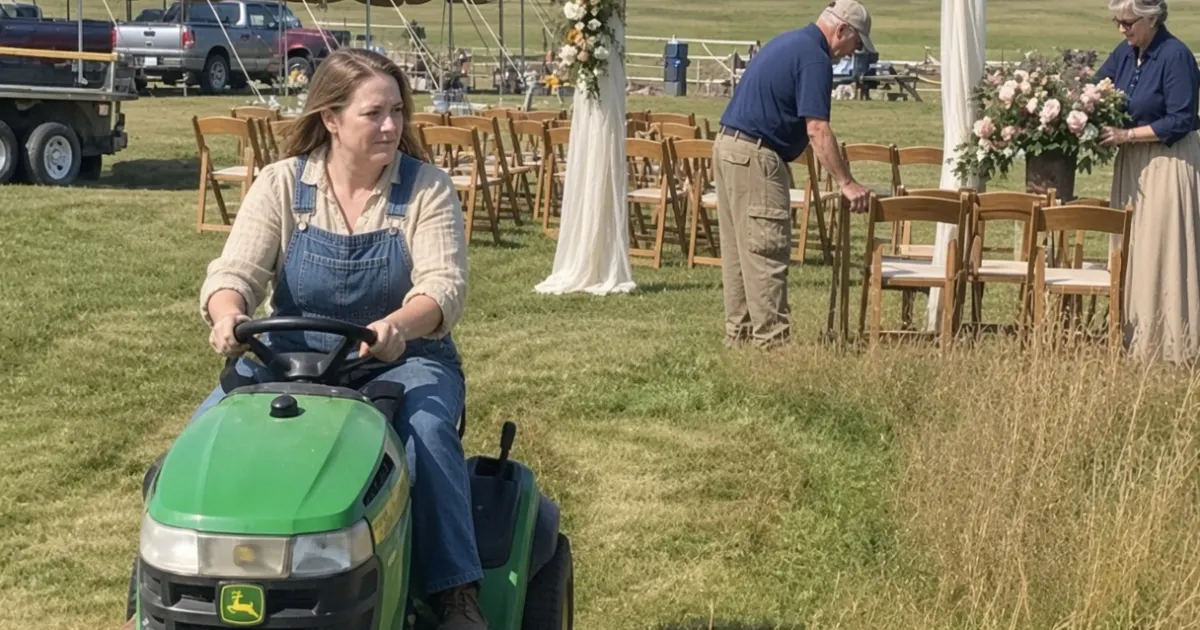
The night before the wedding, after everyone had gone to bed and the tent people had finished their setup and the folding chairs were all in rows on the damp grass and the arbor was draped with white fabric, I walked down to the south hay field in the dark with a flashlight. I stood at the edge of the uncut section behind the arbor, the tall grass, the fifty feet of it that would form the backdrop of every ceremony photograph, the natural green wall that two hundred and twenty people would be staring at while Renae and Dale said their vows. I stood there for a while in the dark. I thought about what I wanted to write. I didn’t want to be mean. I didn’t want to embarrass Renae or start a war or ruin her day. I just wanted to say something true, something that would belong to this land, something that only made sense here. And I thought about Grandpa Leon, the man who bought this soil with everything he had and built it into something that sustained us. I thought about fifty-one years of his labor inside this ground. I thought about the word my sister had used. And I knew exactly what to write. I went back to the machine shed and fired up the old Ford tractor just after four in the morning, working in the dark with the tractor’s headlights on, cutting the rough shapes in the tall hay. Then I switched to the green riding mower to sharpen the edges, working until the sun came up over the tree line and the dew started to burn off. I wore Grandpa’s old barn coat because the June mornings are still cold in Missouri before six o’clock, and the wet grass kept clogging the mower deck, and I had to stop every few minutes to clear the chute with a stick, and by the time the sun was fully up, my fingers were stained dark green and my jeans were wet to the knees. But the letters were coming clear in the golden light. Each one nearly forty feet tall. Four of them. By 7:50, I was finishing the last one. I made the final long pass, reversed carefully in the tight corner, and cut the engine. Then I climbed down off the mower and walked into the middle of what I had written and stood there in the stillness, with the light coming down through the dew and the birds just starting up in the creek bottom. It looked exactly like what it was.
Also readA woman’s chin hair is a sign of…See moreGuests started arriving a little after one o’clock, their cars rolling slowly down the lane in a long, careful line, parking in the lower field where Will and I had laid down gravel. People made their way up the slope in their wedding clothes, fanning out toward the rows of chairs. And then the first ones crested the rise and got the full view of the ceremony field, the white arbor, the rows of chairs, the tents on either side, and the hay field behind it. The hay field that said, in forty-foot golden letters cut into Grandpa’s first cutting: EARL. I watched from beside the barn. A woman in a blue silk dress walked up over the rise and stopped walking. She put her hand over her mouth and stared. The man beside her followed her gaze. Then the people behind him stopped too. Within five minutes, everyone on the slope was looking at the same thing, and the phones were rising, and I could hear people talking to each other, asking about it, reading it. By the time the processional music started, every person at that wedding had seen it. At 1:55, Renae appeared from around the corner of the farmhouse in her dress, holding her bouquet, with our cousin Jeff beside her because our father wasn’t there. She was looking at the guests, smiling, preparing herself. And then she followed everyone else’s gaze toward the hay field. And she saw what I’d written.
She went very still. Jeff said something to her quietly, and she didn’t answer. She stood at the edge of the ceremony field in her white dress with her bouquet held in both hands against her stomach, reading the word I had cut into Grandpa’s hay, and I watched her face from across the field. I had expected a lot of possible reactions. What I did not expect was what actually happened, which was that Renae put her hand over her mouth exactly the way the woman in the blue dress had done, and started to cry. Not angrily. I know what an angry cry from Renae looks like. It was not that. She was crying the other way, the way you cry when something reaches a place inside you that you thought you had closed off. Jeff put his arm around her and she leaned into him, and he was looking at the letters too, and he said something, and she nodded. The wedding coordinator, a young woman named Tess who had been managing the whole thing with a clipboard and an earpiece, walked quickly over to Renae and asked her if she was okay. Renae said yes. Then she said, ask Cassie to come here, please. I didn’t want to interrupt her wedding. I had planned to stay near the barn, out of the photographs. But Tess came and found me and said Renae wanted me, and so I walked across the field to where my sister was standing in her dress with the hay field behind her. When I got there, she looked at me for a long moment without saying anything. Then she said, it says Leon. I said yes. I told her I spelled it wrong at first, out in the dark at four in the morning, and had to fix it. She laughed once, wet and surprised. She said, Leon was his middle name. I told her I knew. She looked at the letters again. Then she said, I called it dirt. I didn’t say anything. She put her hand on my arm and said, I know what I said. I’m sorry. I should have been ashamed of that before you had to remind me. The processional music was just starting, a string quartet playing something soft and slow, and two hundred and twenty people were seated in their white chairs facing the arbor, and in every photograph that would ever be taken of this wedding, Grandpa Leon’s name would be standing forty feet tall in golden hay behind the bride and groom. Renae looked out at the letters one more time and took a long, slow breath. Then she straightened her back, lifted her bouquet, and nodded to Jeff. She was ready to get married.
The ceremony was beautiful. Dale was the kind of man who cried during his own vows, in a good way, and the minister was funny and warm and kept it short. Renae was steady and clear-voiced and radiant. During the ring exchange, the late afternoon sun came over the tree line and hit the hay field at the perfect angle, and the letters glowed, and I saw at least six people in the crowd pull out their phones even though they’d been asked not to. The reception was in the big tent beside the field, and it was everything Renae had planned, the string lights and the wildflower centerpieces and the food from the barbecue restaurant in Warrensburg that she and Dale had loved since their first date. I sat at the family table with Mama and Jeff and his wife, and somewhere in the middle of dinner, Mama leaned over to me and said, very quietly, that she owed me an apology. She said she hadn’t understood what I had given up for the wedding, the hay, the labor, the land. She said she should have asked instead of calling to scold me. I told her it was all right. And it was. That evening, after the first dances and the toasts and the cake, when the reception had loosened into people talking and dancing and spilling out of the tent into the warm night, Renae found me standing at the edge of the hay field in the dark, looking at the letters. She was still in her dress. She came and stood beside me without saying anything for a minute. Then she said she had been wrong. She said she knew she had been wrong before she ever said it; she had felt it the second the word came out of her mouth. She said she told Mama she was in tears because she was embarrassed, not because she was hurt, and that she should have called me instead. She said she had always known, somewhere underneath, that the farm wasn’t just land to me. She said, I just didn’t want to admit that you were the one who stayed and I was the one who left. I told her she hadn’t done anything wrong by leaving. I told her Grandpa never held it against her. She nodded. She looked at the letters again. She said, he would have loved this. I said I knew. The photographs went everywhere. By the next morning, the wedding photographer had posted four of them on her Instagram, and three of them showed the hay letters behind the ceremony, and all three had been shared thousands of times by the time I woke up and went down to do the morning chores. A local news station in Columbia called and asked if they could do a story. I said no, but thank you. It wasn’t meant to go anywhere but that field.
The last thing I did that June was something I hadn’t planned on doing until the morning after the wedding, when I walked down to the south field to assess what was left of the hay. The ceremony area was rough and rutted from two hundred and twenty people walking through it and chairs being dragged across it, and the tent footprints had flattened wide circles in the grass, and it would need work before the second cutting could be taken. And the letters, of course. The letters had been mowed down to the soil. That section of the field would take another season to fully recover. I stood there in the early morning light, looking at the shape of where LEON had been, the slightly paler ground where the grass was gone, and I made a decision. I called Will, my neighbor, and asked if he would help me drive some stakes. That afternoon, Will and I went down to the hay field and drove four wooden stakes in the ground, one at each corner of the word’s footprint, and ran a simple rope between them, marking off the section. Then I went to the hardware store in Warrensburg and bought a small piece of pressure-treated lumber and a can of dark green paint, and I painted a name on it and staked it in the center of the roped-off rectangle. It said, in letters I painted freehand with a brush: Leon Earl Parsons, 1948-2022. This ground is his. The hay will grow back over it and the marker will weather, and eventually the whole thing will blend back into the field the way everything does eventually. But for now, in the middle of the south slope field, there is a small rectangle of ground with a name on it, and when the grass comes back in this season’s second cutting, it will grow up over that name and over those four enormous letters I mowed in the dark before my sister’s wedding. I walk down there some mornings to check on it. I wear Grandpa’s barn coat because the mornings are still cold in Missouri, even in July. And I think about him buying this land with everything he had and building it into something that held us up when we needed it. And I think about Renae standing in her dress in the June light, crying the kind of crying that means something has finally come clear. And I think about what it really means when someone you love calls your inheritance dirt, and what it means when they realize they were wrong. Grandpa always said the land teaches you patience, because nothing on a farm happens fast, and that the most important things are the ones you do in the quiet and the dark, when nobody is watching. He was right about most things. He was right about that.
This article is general information, not personal medical or financial advice. Talk to a qualified professional about your own situation.