Most people have absolutely no clue about this. 😳
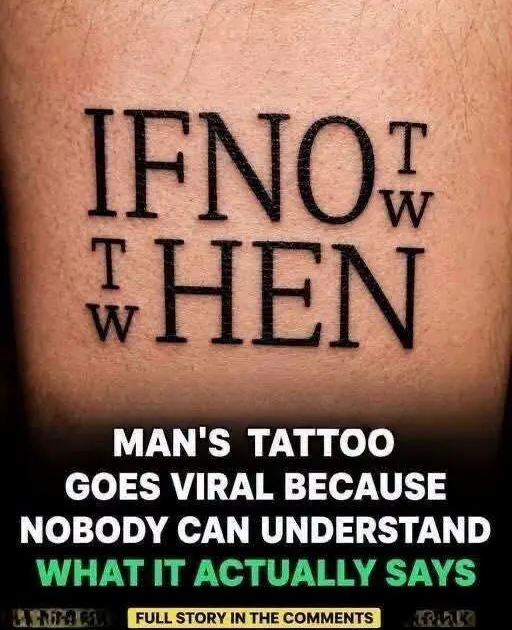
Eventually, frustration began replacing confidence. Some viewers admitted defeat entirely, convinced they lacked whatever special ability was required to read the tattoo. Others jokingly wondered whether the entire image had been created as an elaborate prank designed to waste countless hours of collective attention. The more closely people examined the overlapping lines, the farther away the answer seemed to drift.
Instead of fading into internet obscurity, the tattoo became strangely addictive. People who normally had little interest in tattoos found themselves returning repeatedly to the photograph. They would zoom in, study one section carefully, become convinced they were close to understanding it, then realize they were just as confused as before. Many described the experience as mentally exhausting but impossible to abandon. It became the kind of puzzle that lingered in people’s minds long after they had closed the image.
After days of speculation and thousands of comments, online communities gradually pieced together the intended message. The tattoo was supposed to read: “If not now, then when.” The phrase is a familiar expression encouraging people to act decisively instead of endlessly postponing important decisions. It appears regularly in motivational books, speeches, and self-improvement advice, making it instantly recognizable once the answer became known.
Yet an unusual problem remained. Even after learning the correct phrase, many people still could not actually see it in the tattoo itself. Knowing the solution did not suddenly make the design easier to read. Instead, viewers often found themselves tracing individual letters repeatedly, trying to understand how the completed sentence had become so thoroughly hidden within the artwork. For some, the mystery remained unsolved despite having the answer directly in front of them.
Ironically, that contradiction became the most fascinating aspect of the story. The quote itself encourages clarity, urgency, and decisive action. It reminds people not to delay pursuing meaningful goals. Yet the tattoo’s visual design buries that simple message beneath overwhelming complexity. The very words intended to inspire confidence became trapped inside a puzzle that left almost everyone confused.
There is a surprisingly profound lesson hidden within that irony. Many of our best intentions begin as simple ideas. We want to improve ourselves, communicate honestly, take chances, or move forward with purpose. But as those intentions pass through everyday challenges, compromises, misunderstandings, and unexpected complications, they often become far more difficult for others—and sometimes even ourselves—to recognize. Like the tattoo, the original message can become obscured without ever changing at its core.
That may explain why so many people found the story unexpectedly relatable. Beyond the humor and online frustration lies something deeply human. Most people carry ambitions, dreams, or personal values that make perfect sense in their own minds yet appear confusing or invisible to everyone else. We often believe we are communicating one thing while the world receives something entirely different.
For the man wearing the tattoo, the design almost certainly continues to represent determination, courage, and personal meaning. Every glance at his arm likely reminds him of the message he originally intended to preserve. For millions of strangers online, however, the same tattoo became an unsolved visual riddle. The contrast highlights the difference between private understanding and public perception—a difference that exists in far more areas of life than body art alone.
Now that the viral excitement is beginning to fade, the conversation has shifted away from identifying the quote and toward understanding how the design reached this point. There may never be a definitive answer. Perhaps the wearer became so focused on symbolism that readability seemed less important. Perhaps the tattoo artist faithfully executed a concept without fully appreciating how difficult it would be to interpret. Or perhaps both simply underestimated how dramatically an ambitious layout could affect legibility.
Whatever the explanation, the tattoo has achieved something neither the wearer nor the artist likely anticipated. It has become more than a motivational quote. It has become a lasting reminder that intention and execution are not always the same thing, and that even the clearest messages can become surprisingly difficult to understand when the path between an idea and its final form grows too complicated. In that sense, the tattoo’s greatest lesson may not be the words it contains, but the unexpected story it ended up telling.
This article is general information, not personal medical or financial advice. Talk to a qualified professional about your own situation.