The third carried the letterhead of a law firm.
And at the bottom of the final page was a name I hadn’t heard in twenty-five years.
Margaret Ellison.
My father’s attorney.
Then I noticed the date.
The document had been signed only eleven days before my father died.
My mother saw it.
Her expression changed instantly.
“Claire, put those papers away.”
I looked at her.
“Why?”
“Because they are private.”
“They have my name on them.”
“Your father didn’t know what he was doing.”
I looked down again.
There was one more sentence in the letter.
A sentence that made my hands go cold.
Your brother believes the house belongs to him. Your mother has told him that for years. But Claire, the house was never legally theirs to give away.
I slowly raised my eyes.
“Which house?”
Patricia didn’t answer.
Derek did.
“The house we live in.”
I looked at him.
“What?”
He swallowed.
“The house Dad left us.”
I stared at the documents.
Then I looked at my mother.
And suddenly, I understood why she had been so terrified when she saw that envelope.
Because the house wasn’t the only thing my father had left behind.
There was something else.
Something worth far more than the property.
At the bottom of the final document, beneath my father’s signature, was a reference to a trust.
A trust established twenty-five years earlier.
And the beneficiary’s name was mine.
I looked at Thomas.
“Do you know anything about this?”
He shook his head.
“No, Admiral. But I think you need to speak with the attorney.”
My mother stepped closer.
Her voice dropped to a whisper.
“Claire, please. Whatever you think you know, don’t destroy this family.”
I looked at her for several seconds.
Then I folded the documents carefully and placed them back inside the envelope.
“Mother,” I said quietly, “you threw me out of this family twenty-five years ago.”
Her eyes filled with tears.
“And now,” I continued, “you’re asking me to protect something you never allowed me to belong to.”
I turned away.
But before I could take another step, Derek said something that stopped me.
“Claire, wait.”
I looked back.
His face had changed.
The arrogance was gone.
He looked frightened.
“There’s something else you should know about Dad’s house.”
I waited.
Derek glanced at our mother.
Then he looked at me.
“Mom sold it six months ago.”
My stomach tightened.
“What?”
He swallowed.
“She told me she had the right to sell it. She said Dad had transferred everything to her before he died.”
I stared at him.
“Who bought it?”
Derek hesitated.
Then he gave me an answer I wasn’t prepared for.
“An investment company.”
“Which one?”
He looked down.
“Carter Holdings.”
I froze.
That name was familiar.
Too familiar.
Because Carter Holdings wasn’t just an investment company.
It was the company my father had established through the trust.
The same trust whose documents were now sitting inside my hands.
I looked at the paperwork again.
Then I noticed something I had missed.
The sale date.
Six months earlier.
And the signature authorizing the transfer.
It wasn’t my father’s.
It wasn’t mine.
It was Patricia Carter’s.
I slowly looked up.
“Mother,” I said, “what exactly did you sell?”
She didn’t answer.
Derek took a step backward.
And then my phone began vibrating.
An unknown number appeared on the screen.
I answered.
A woman’s voice spoke immediately.
“Admiral Carter? This is Margaret Ellison. I have been trying to reach you for several months.”
I gripped the phone.
“I’m listening.”
She paused.
Then she said something that made the blood drain from my face.
“Your father’s trust has been compromised. Someone has attempted to transfer assets worth approximately $18.6 million without the beneficiary’s authorization.”
I looked directly at Patricia.
Margaret continued.
“And Admiral, there’s one more thing. The signature on the transfer documents appears to be fraudulent.”
I couldn’t speak.
Then Margaret added:
“Your mother isn’t the only person involved. Your brother signed the final authorization.”
Across the ballroom, Derek’s phone suddenly began ringing.
He looked at the screen.
Then he looked at me.
And for the first time in his life, my brother looked as though he understood that some consequences could not be laughed away.
Derek’s phone continued ringing.
He stared at the screen as though the device itself had become dangerous.
My mother reached for his arm.
“Don’t answer that.”
He looked at her.
“Why?”
“Derek, just give me the phone.”
But he stepped away.
For the first time that evening, he wasn’t following her instructions.
I stood near the ballroom entrance, holding my father’s letter in one hand and my phone in the other.
Margaret Ellison was still on the line.
“Admiral Carter, are you there?”
“Yes. I’m here.”
“I need you to listen carefully. I don’t want you confronting anyone or signing anything until you’ve reviewed the original documents.”
“Tell me exactly what happened.”
She took a breath.
“Your father established Carter Holdings through a family trust twenty-five years ago. He wanted to ensure that you would have financial independence regardless of what happened to him. He appointed independent trustees and designated you as the primary beneficiary.”
I looked toward my mother.
She was watching me.
“Why wasn’t I informed?”
“Your father instructed me to contact you when you were ready. Unfortunately, after his death, Patricia contacted our office and claimed you had voluntarily relinquished your interest.”
“I never signed anything.”
“I know. That’s why I kept the original documents.”
Margaret continued.
“Your mother subsequently attempted to manage certain assets. We challenged several transactions, but the latest attempted transfer involved the sale of the family property and a substantial portion of the investment portfolio.”
“How much?”
“Approximately $18.6 million in assets were affected by the attempted transactions. We are still determining the full amount of any money actually transferred.”
I closed my eyes.
Eighteen million six hundred thousand dollars.
My father had spent his final months trying to protect something for me.
And my family had spent twenty-five years pretending he left me nothing.
“Margaret,” I said, “I want everything reviewed legally. Every document. Every transaction. Every signature.”
“Already underway.”
“And I want no one accessing the trust until the matter is resolved.”
“That’s exactly what we’re working to secure.”
I ended the call.
When I looked up, my mother was crying.
Not quietly.
Not gracefully.
She was crying the way people cry when they realize the story they have told for years is finally falling apart.
“Claire, please.”
I said nothing.
She stepped closer.
“You have to understand. Your father was very sick. I was trying to keep everything together.”
“You sold property that wasn’t yours.”
“I was protecting the family!”
“By forging documents?”
She flinched.
Derek suddenly interrupted.
“Wait. You told me Dad transferred the company to you.”
Patricia turned sharply.
“Not now, Derek.”
“You told me everything was legally yours.”
“I said not now!”
He looked at me.
“Claire, I didn’t know.”
I studied his face.
For a moment, I almost believed him.
Then I remembered the final authorization Margaret had mentioned.
“You signed the documents,” I said.
Derek shook his head.
“Mom told me it was paperwork to finalize the property sale.”
“You didn’t read what you signed?”
“I trusted her.”
I stared at him.
“You trusted her enough to sign away millions of dollars belonging to someone else?”
He had no answer.
And that was when I realized something.
My brother had never considered the possibility that he could be wrong because, for most of his life, someone else had always cleaned up after him.
But this time, nobody was coming to rescue him.
The following morning, I met Margaret Ellison at her law office.
I arrived wearing civilian clothes.
No uniform.
No medals.
No rank.
Just a dark blue jacket, a white blouse, and my father’s old wristwatch.
I wanted to understand what he had left me without the distraction of what had happened at the gala.
Margaret was waiting in a conference room with three thick folders.
She was in her late sixties, with short silver hair and a calm expression.
When I entered, she stood.
“Claire.”
I shook her hand.
“Thank you for keeping your promise to my father.”
She looked at the watch on my wrist.
“He would have liked seeing you wear that.”
I sat down.
“Tell me everything.”
Margaret opened the first folder.
“Your father founded Carter Holdings with a small commercial property investment. Over the years, he expanded the business into several areas, including commercial real estate, industrial leasing, and long-term investment management.”
She showed me the original trust agreement.
“Before his death, he transferred controlling interests into an irrevocable trust. You were named the primary beneficiary.”
I looked at the document.
My name appeared on the first page.
Claire Elizabeth Carter.
My hands trembled.
“How much was it worth when he died?”
“Approximately $6.2 million.”
I looked up.
“And now?”
“After years of investment growth and property appreciation, the portfolio was valued at approximately $18.6 million before the disputed transactions.”
I sat back.
My father had built something extraordinary.
And I had spent twenty-five years believing he had left me nothing but a wristwatch and a few letters.
Margaret turned to another document.
“Your mother was never a beneficiary of the trust. She had limited authority to manage certain household matters, but she was not authorized to sell trust property or transfer controlling interests.”
“Then how did she do it?”
“She submitted documents claiming that you had signed a waiver relinquishing your rights.”
“That’s impossible.”
“I know.”
Margaret slid a photocopy across the table.
The signature at the bottom looked similar to mine.
But it wasn’t mine.
Someone had copied it.
I stared at the page.
“Who submitted this?”
“Your mother.”
I looked at the next document.
A transfer authorization.
Derek’s signature appeared beneath Patricia’s.
I recognized it immediately.
“Why would Derek sign this?”
Margaret folded her hands.
“Your mother claimed that he had been appointed as your representative.”
I almost laughed.
“I’m a Navy admiral. I’ve never appointed Derek to represent me in anything.”
Margaret nodded.
“Which is why the documents are now under formal investigation.”
She opened the final folder.
“There is something else.”
I looked at her.
“Go ahead.”
“Your father left a personal letter with instructions that I was to give it to you after you had reviewed the trust documents.”
She removed a sealed envelope.
My name was written across the front.
The handwriting was unmistakable.
I opened it.
My dear Claire,
If Margaret has finally given you this letter, then I know the truth has reached you.
I need you to understand something before you judge yourself for what happened.
You were never the problem in our family.
Your mother and I disagreed about many things. But the day you told us you wanted to join the Navy, I saw something in your eyes that I had not seen in your brother.
You had a purpose.
Your mother wanted you to follow the path she had chosen. Derek wanted the world to revolve around him. But you wanted to build something of your own.
I should have defended you more strongly.
I should have stopped your mother from throwing you out.
I have regretted that day every single morning since it happened.
I stopped reading.
My eyes were already full of tears.
I hadn’t cried over my father in years.
But suddenly, I was nineteen again.
Standing outside the house.
Holding that black trash bag.
Wondering why the one person who might have protected me hadn’t come through the door.
I continued.
I know your mother will tell you that I was confused, that I was sick, and that I never intended for you to receive anything.
Don’t believe her.
I established this trust because I wanted you to have a future that nobody could take away from you.
But I want you to remember something more important than money.
Do not allow what I leave you to become the reason you lose yourself.
If your mother and brother have made mistakes, let the law deal with those mistakes. Do not let anger become the rest of your life.
You have already survived more than I ever wanted you to experience.
I am proud of you, Claire.
I was proud of you when you left home.
I was proud of you when you became a sailor.
And I would have been proud of you even if you had never become an admiral.
You were always enough.
Love,
Dad.
I lowered the letter.
For several seconds, Margaret said nothing.
Then she gently placed a box of tissues beside me.
I took one.
“I thought he was disappointed in me,” I whispered.
Margaret shook her head.
“No, Claire. He was disappointed in himself for not protecting you sooner.”
That sentence broke something inside me.
And for the first time in twenty-five years, I allowed myself to grieve the father I had lost.
Not the man my mother had described.
The man who had secretly believed in me all along.
Three weeks later, the investigation reached a turning point.
Margaret contacted me early on a Tuesday morning.
“We have a development.”
I was at my office reviewing paperwork.
“What happened?”
“The bank provided the transaction records. We traced several transfers from accounts associated with the disputed property sale.”
“Where did the money go?”
“Some went to a company connected to Derek. Other amounts were transferred to personal accounts.”
I sat down.
“How much?”
“Approximately $2.1 million in transfers are currently under review.”
I closed my eyes.
“Is there evidence of fraud?”
“Investigators are examining the forged waiver, the transfer authorizations, and the financial trail. We have also obtained messages showing that your mother knew the trust required your authorization.”
“Messages?”
“Yes.”
Margaret paused.
“One of them is particularly important.”
She read the message aloud.
Once Claire signs nothing, we can still tell the bank the paperwork was completed before she left. She has been gone for twenty-five years. Nobody will believe she has any interest in the company.
My stomach tightened.
“Who sent it?”
“Your mother.”
“And who received it?”
“Derek.”
I didn’t respond.
Margaret continued.
“There is another message from Derek.”
“What did he say?”
She paused.
“He wrote, ‘Just make sure the money clears before she finds out.’”
I stared at the wall.
There was no misunderstanding anymore.
No innocent paperwork.
No family confusion.
My brother knew something was wrong.
And he had helped.
I thanked Margaret and ended the call.
Then I sat alone for a long time.
I thought about all the birthdays I had spent without them.
All the holidays.
All the times I had wondered whether my father would have wanted me to make peace.
I had spent years believing that perhaps I was too stubborn.
Perhaps I should have called more often.
Perhaps I should have forgiven my mother sooner.
But now I understood something.
Forgiveness could never mean pretending the truth hadn’t happened.
And love could never require me to surrender my dignity.
The next confrontation happened in a small conference room at Margaret’s office.
Patricia arrived wearing a cream-colored suit and carrying an expensive handbag.
Derek followed her.
Neither looked particularly happy.
My mother sat opposite me.
“Claire,” she began, “I’m glad we can finally talk like adults.”
I looked at her.
“Let’s talk about the documents.”
She sighed.
“I knew you would say that.”
Margaret placed several papers on the table.
“These are copies of the disputed transfer records. We have also provided the relevant financial statements to the appropriate investigators.”
PART 5
Patricia glanced at them.
“Then explain it,” I said.
She looked at me.
“Your father was sick. The company needed someone to manage it. I had to make decisions.”
“You were not authorized to sell the trust’s assets.”
“I was his wife!”
“And I was his daughter.”
She looked away.
Derek leaned forward.
“Look, Claire. We can settle this privately.”
I turned toward him.
“How?”
“We reverse whatever transactions we can. You get the company. We figure out a reasonable arrangement.”
I stared at him.
“A reasonable arrangement?”
He nodded.
“Everyone gets something. We move on.”
I almost smiled.
“You mean I should negotiate with you over property my father already left to me?”
Derek rubbed his forehead.
“Don’t make this harder than it needs to be.”
I looked at him.
“You hit me.”
He went silent.
“You helped submit documents with my forged signature.”
He looked down.
“And now you’re asking me to make things easier for you?”
Patricia interrupted.
“Claire, please. Your brother made a mistake.”
I turned toward her.
“You told him to do it.”
Her face tightened.
“I was trying to protect what your father built.”
“No. You were trying to control it.”
For several seconds, nobody spoke.
Then my mother leaned forward.
“Do you know what people will say if this becomes public?”
I looked at her.
“That isn’t my concern.”
“Our family will be destroyed.”
I took a breath.
“Mother, our family was already destroyed when you decided that one child deserved everything and the other deserved nothing.”
Her eyes filled with tears.
“After everything I’ve done for you…”
I interrupted her.
“Tell me one thing you did for me after I was nineteen.”
She opened her mouth.
Nothing came out.
I continued.
“You didn’t come to my graduation. You didn’t attend my first promotion ceremony. You didn’t visit when I was hospitalized after an operation. You didn’t call when I was assigned overseas. You didn’t even send a message when I became an admiral.”
Derek shifted in his chair.
I looked directly at my mother.
“But you had time to tell everyone that I was a failure.”
She began crying.
I didn’t raise my voice.
“I spent twenty-five years trying to earn the approval of someone who had already decided I wasn’t worth supporting.”
I gathered the papers in front of me.
“I’m finished doing that.”
Margaret explained that any settlement would have to be handled through legal counsel and that neither Patricia nor Derek could make decisions on behalf of the trust.
The meeting ended without an agreement.
As they stood to leave, Derek turned toward me.
“Claire, wait.”
I stopped.
His voice was quieter now.
“I’m sorry about the slap.”
I looked at him.
He swallowed.
“I shouldn’t have done that.”
For a moment, I wanted to believe him.
Then he added:
“But you have to understand how embarrassing it was when everyone stood up for you.”
And just like that, I understood.
He wasn’t sorry about hurting me.
He was sorry about being exposed.
I nodded once.
“Goodbye, Derek.”
The legal process continued for several months.
The disputed property sale was challenged.
The trust’s records were secured.
The bank accounts were reviewed, and the attempted transfers were investigated.
The forged waiver became a central piece of evidence.
Derek’s involvement was also examined.
I did not interfere with the investigation.
I did not call anyone to demand special treatment.
I did not use my Navy position to influence a single decision.
My lawyers handled the civil matters, while the appropriate authorities handled the allegations.
Eventually, the court recognized that the disputed property belonged to the trust and that the purported waiver was not valid.
The property transfer was reversed.
The trust’s remaining assets were secured.
The financial investigation also established that money had been improperly transferred, and recovery proceedings began.
My mother was required to account for the transactions she had authorized.
Derek faced separate legal consequences for his role in the attempted transfers.
The process was not quick.
It was not glamorous.
And it certainly wasn’t the dramatic courtroom victory my mother had always feared.
It was paperwork, testimony, financial records, and months of uncomfortable questions.
But the truth finally had somewhere to stand.
One afternoon, Margaret called.
“Claire, the latest court order has come through.”
I was sitting at my desk.
“What does it say?”
“The trust’s ownership has been confirmed. The disputed transfer documents cannot be used to establish ownership, and the recovery process will continue under the court’s supervision.”
I closed my eyes.
“Thank you.”
Margaret smiled through the phone.
“Your father would be relieved.”
I looked at his photograph.
“I hope so.”
Six months after the gala, I returned to the property where I had grown up.
The house looked smaller than I remembered.
The white paint had faded.
The front garden was overgrown.
The old oak tree still stood beside the driveway.
I parked outside and remained in the car for several minutes.
This was the place where my mother had thrown me out.
The place where my brother had laughed.
The place where my father had watched helplessly as I walked away.
I stepped out.
A caretaker had been maintaining the property while the legal matters were resolved.
He handed me the keys.
“Everything is ready, Admiral.”
I thanked him.
Then I opened the front door.
The smell of the house was familiar.
Old wood.
Furniture polish.
Dust.
I walked slowly through the living room.
My father’s old chair was still beside the window.
The same chair where he used to sit and read the newspaper.
I touched the armrest.
Then I noticed something on the bookshelf.
A small wooden box.
I recognized it immediately.
It had belonged to my father.
Inside were photographs, old letters, and a collection of Navy postcards I had sent him during my early years of service.
He had kept every single one.
Even the postcards with nothing more than a few sentences.
One photograph showed me at nineteen, standing beside a Navy recruiting office.
I was smiling.
My hair was shorter.
My uniform was new.
I looked so young.
Behind the photograph, my father had written:
She has no idea how strong she is.
I sat down in his chair.
And I cried.
Not because of the money.
Not because of my mother.
But because my father had seen me.
Even when I thought nobody did.
A few weeks later, I received a letter from Derek.
It arrived in a plain white envelope.
No expensive stationery.
No dramatic language.
Just my name and a return address.
I opened it.
Claire,
I know you probably don’t want to hear from me.
I’ve spent a lot of time thinking about what happened.
I used to believe that everything came easily to you because you had a uniform and a career that people respected. I never understood what it took for you to get there.
Mom always told me you were selfish. I believed her because it was easier than questioning anything.
I signed documents I should have read. I accepted money I should have questioned. And I treated you like someone who didn’t matter.
I am sorry.
I don’t expect you to forgive me.
Derek.
I read it twice.
Then I placed it inside the drawer with my father’s letters.
I didn’t respond immediately.
I didn’t owe him an answer.
But I also didn’t want to spend the rest of my life carrying hatred.
Several months later, I agreed to meet him at a quiet coffee shop.
He arrived early.
He looked older.
Not physically.
Something about his confidence had disappeared.
We sat across from each other.
For several minutes, neither of us spoke.
Finally, he said:
“I thought you would never come.”
“I wasn’t sure I would.”
He nodded.
“I deserved that.”
I looked at him.
“Why did you hit me?”
He stared at his coffee.
“Because I was angry.”
“At what?”
He hesitated.
“At you.”
I waited.
He continued.
“You had become everything Mom said you never would. You had a career. People respected you. And I was still pretending I was something I wasn’t.”
I didn’t interrupt.
“I hated that everyone knew who you were while I had spent years pretending I was the successful one.”
He looked up.
“I know that’s not an excuse.”
“No,” I said. “It isn’t.”
He nodded.
“I also know saying sorry doesn’t fix anything.”
“That’s true.”
He looked down again.
“Can we ever be family again?”
I thought about that question.
I thought about the years we had lost.
The childhood memories.
The humiliation.
The documents.
The slap.
Then I answered honestly.
“Maybe. But it won’t happen because you ask me to forget.”
He nodded slowly.
“It would have to happen because you change.”
“I understand.”
I stood.
He didn’t try to stop me.
For the first time, our conversation ended without shouting.
That was enough for that day.
I didn’t know whether Derek would become a better person.
But I had finally stopped believing that his future was my responsibility.
My mother contacted me one last time.
It was almost a year after the gala.
She called late on a Sunday evening.
I almost didn’t answer.
But something made me pick up.
“Claire?”
“Yes.”
Her voice sounded tired.
“I know you don’t want to speak to me.”
I said nothing.
“I’ve been thinking about your father.”
I looked toward the window.
“So have I.”
She began crying.
“He used to talk about you all the time.”
I closed my eyes.
“I know.”
“He kept your photographs in his desk.”
“I found them.”
There was a long silence.
Then she said something I had waited twenty-five years to hear.
“I was wrong to throw you out.”
I gripped the phone.
“I know.”
“I was wrong to make you feel like you weren’t good enough.”
My throat tightened.
“I know.”
“And I was wrong about the Navy.”
I took a breath.
“Mother, I don’t need you to approve of my career anymore.”
“I understand.”
“No. I don’t think you do.”
I sat down.
“For years, I thought if I became successful enough, you would finally be proud of me. I thought if I received another promotion, another award, another responsibility, you might look at me differently.”
She was crying quietly.
“But I eventually learned that I couldn’t build my life around trying to change your opinion.”
“I am sorry, Claire.”
I looked at the photograph of my father.
“I believe you regret some of what happened.”
“Can you forgive me?”
I didn’t answer immediately.
Then I said:
“I am working on forgiving you. But forgiveness doesn’t mean you get the same access to my life that you had before.”
She began crying harder.
“I understand.”
“Goodbye, Mother.”
I ended the call.
And for once, I didn’t feel guilty.
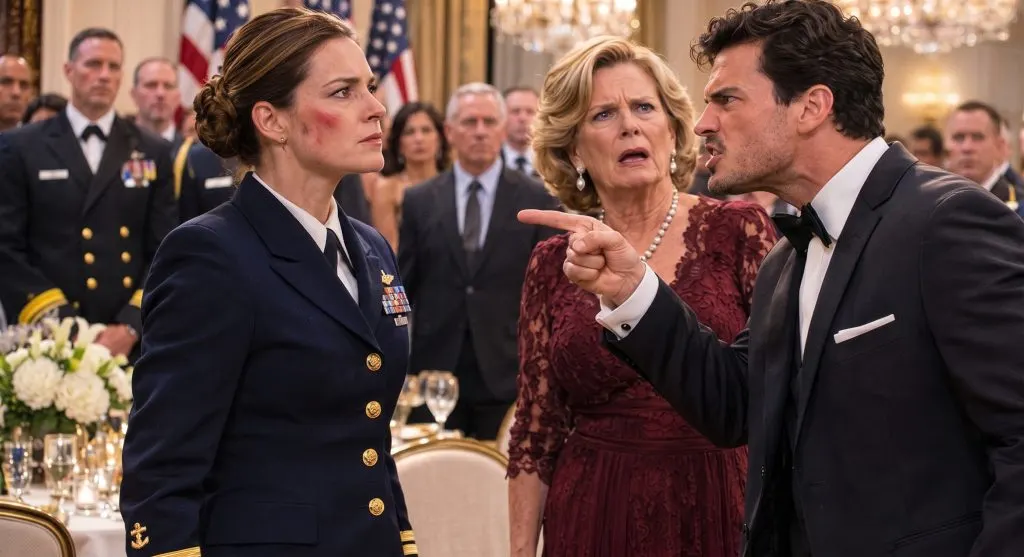
One year after the incident, I returned to the annual Navy gala.
The same ballroom.
The same chandeliers.
The same American flags.
But this time, I arrived without fear of seeing my family.
Master Chief Keating spotted me near the entrance.
“Admiral Carter!”
I smiled.
“Master Chief.”
He shook my hand.
“Good to see you again, ma’am.”
“Good to see you too.”
He looked around the room.
“Funny how much can change in a year.”
I glanced toward the table where Derek had stood the previous year.
“I suppose it can.”
The event coordinator approached.
“Admiral, we’re ready for you.”
I walked toward the stage.
This time, I had prepared a different speech.
I spoke about leadership.
I spoke about responsibility.
I spoke about the young people who joined the Navy with nothing but determination and a willingness to serve.
And near the end, I shared a lesson I had learned outside the military.
“Some of the hardest battles we fight happen in places where nobody wears a uniform.”
The room became quiet.
“Sometimes, the people who hurt us are the people we spent our entire lives trying to impress. Sometimes, we spend years believing that if we become successful enough, they will finally recognize our worth.”
I paused.
“But your worth was never waiting for someone else’s approval.”
I looked across the audience.
“Do not spend your life trying to prove something to people who have already decided not to see you. Build a life that reflects your values. Treat people with dignity. Take responsibility for your actions. And never confuse forgiveness with allowing someone to hurt you again.”
The applause filled the ballroom.
Master Chief Keating stood.
Then the others followed.
I returned the salute.
And for the first time, the moment reminded me of something other than the slap.
It reminded me of why I had chosen this life.
After the ceremony, I returned home.
Not to my mother’s house.
To a small coastal home I had purchased years earlier.
It wasn’t enormous.
It didn’t have marble floors or expensive chandeliers.
It had a garden, a comfortable living room, and a porch where I could sit in the evening and watch the sun disappear over the water.
On my desk was a photograph of my father.
Beside it was the small wooden box containing his letters.
I opened the box and removed the final letter.
The one I had read so many times that the folds were beginning to weaken.
I read the last sentence again.
You were always enough.
I smiled.
For twenty-five years, I had believed my family had taken something from me.
And in some ways, they had.
They had taken birthdays.
They had taken holidays.
They had taken the comfort of knowing that the people who raised me would always stand behind me.
But they had not taken my future.
They had not taken my purpose.
They had not taken the career I built, the sailors I served beside, or the people who became my family along the way.
And they had not taken the love my father had left me.
I placed the letter back inside the box.
Then I walked outside.
The evening air was cool.
My phone vibrated.
A message from Derek appeared.
Hope you’re doing well, Claire. I’m trying to do better.
I read it.
Then I put the phone away.
Maybe one day we would rebuild something.
Maybe we wouldn’t.
Either way, I was no longer waiting.
I had spent twenty-five years trying to prove that I belonged somewhere.
Now I finally understood that home wasn’t a place where people demanded that I make myself smaller.
Home was where I could stand without apologizing for who I had become.
And as I looked out at the ocean, I remembered the nineteen-year-old girl standing outside a house with a black trash bag in her hands.
I wished I could go back and tell her something.
I wished I could hold her shoulders and tell her that the years ahead would be difficult.
That she would cry.
That she would doubt herself.
That she would lose people she loved.
But I would also tell her that one day, nearly four hundred Navy officers would stand in a ballroom because they respected the woman she had become.
And I would tell her something even more important.
She didn’t need four hundred people to stand up for her.
She had been worthy of respect all along.
The girl who was thrown out at nineteen had become a woman who could no longer be thrown away.
And that was the victory no amount of money could ever measure.