I Almost Threw Away My Breakfast After Seeing This Inside an Egg
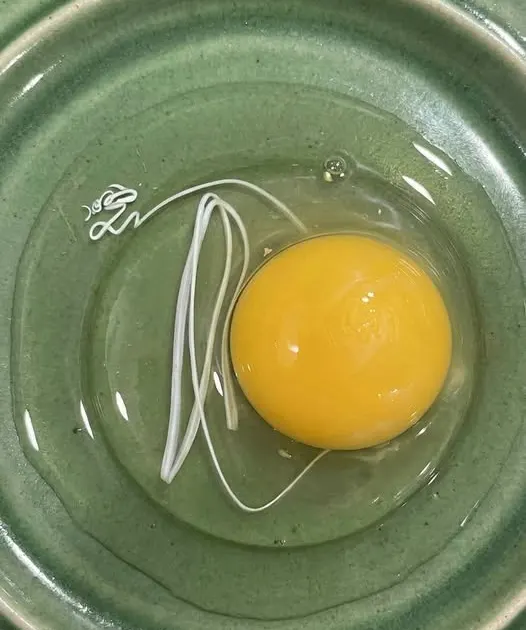
Humans naturally pay attention to unexpected details. From an evolutionary standpoint, caution around unfamiliar foods makes sense. For thousands of years, identifying spoiled or unsafe food sources was an important survival skill. Even today, many people react strongly when they notice something that looks different from what they expected.
Yet unfamiliar does not necessarily mean harmful.
Food products often contain natural variations that may surprise consumers who are accustomed to seeing only the finished product. Fruits come in different shapes and sizes. Vegetables may develop unusual colors or patterns. Eggs can display characteristics that are completely normal despite appearing unfamiliar.
The chalaza is one example of this phenomenon.
Because it blends into the egg white, many people never notice it. However, when it appears more prominently, it can easily attract attention. For someone seeing it clearly for the first time, it may seem unusual enough to raise questions.
Also readA Rare Public Appearance After Six Years — The Emotional Story Behind an Oscar Winner’s RecoveryProfessional chefs and experienced cooks generally recognize the chalaza immediately.
Many have encountered it countless times while preparing meals. Some recipes even involve removing it for aesthetic reasons, particularly when creating very smooth custards, sauces, or desserts. However, removing it is a matter of preference rather than necessity.
The chalaza is perfectly edible.
Once I learned that fact, breakfast preparation suddenly became much less stressful.
Instead of worrying about the egg, I found myself fascinated by how little I knew about something I had eaten throughout my life. Eggs are among the most common foods in many households, yet few people spend time learning about their internal structure.
The more I researched, the more interesting the topic became.
An egg is a remarkably sophisticated biological package. Every component serves a purpose. The shell provides protection. The membranes help create barriers. The egg white supplies nutrients and cushioning. The yolk contains valuable nutrients that support development. Even the chalaza contributes by helping maintain the yolk’s position.
What initially looked like an oddity was actually part of an elegant natural design.
This discovery led me to think about how often misconceptions arise from incomplete information.
A quick glance at something unusual can trigger assumptions. Without context, people may interpret unfamiliar features as signs of damage, contamination, or poor quality. Yet a little research frequently reveals a very different explanation.
The internet can sometimes contribute to confusion, but it can also be an excellent educational resource when used carefully. Reliable food safety organizations, agricultural institutions, and culinary experts provide valuable information that helps consumers better understand the foods they purchase and prepare.
In my case, a few minutes of reading transformed uncertainty into confidence.
Rather than discarding a perfectly good egg, I gained a useful piece of knowledge that I will remember whenever I cook in the future.
The experience also highlighted the importance of food education.
Many consumers grow up learning basic cooking skills but receive little information about the science behind common ingredients. Understanding how foods are produced, stored, and prepared can help people make informed decisions while reducing unnecessary waste.
Get Writing Tools
Food waste remains a significant challenge in many parts of the world.
Every year, large quantities of perfectly edible food are discarded because people mistakenly believe something is wrong with it. Misunderstandings about appearance, freshness, labeling, or natural variations often contribute to this problem.
Learning to recognize normal characteristics can help reduce unnecessary waste while increasing confidence in the kitchen.
Shop Kitchenware
Eggs, in particular, are frequently misunderstood.
People may become concerned about shell color, yolk color, white strands, blood spots, or other natural variations. In many cases, these characteristics are harmless and do not affect safety or quality. Understanding the difference between normal variation and genuine spoilage is an important skill for home cooks.
Of course, proper food safety practices still matter.
Consumers should always inspect foods carefully, store them appropriately, and follow recommended handling guidelines. If an egg has an unusual odor, visible spoilage, or signs of damage that raise legitimate concerns, caution is appropriate.
However, a visible chalaza by itself is not a cause for alarm.
In fact, many experts consider it a sign that the egg is relatively fresh.
By the time I finished reading, my initial concern had completely disappeared.
The egg that had interrupted my morning routine was now serving as an unexpected lesson in food science. What began as a moment of uncertainty ended as a reminder that appearances can sometimes be misleading.
I eventually cooked the eggs and enjoyed breakfast as planned.
Yet the experience stayed with me long afterward because it illustrated how quickly assumptions can form when we encounter something unfamiliar. It also demonstrated the value of taking a moment to gather accurate information before jumping to conclusions.
Today, if I notice a chalaza in an egg, I barely think twice about it.
Instead of seeing something strange, I see a normal part of the egg’s structure doing exactly what it is supposed to do. What once seemed unusual now appears completely ordinary.
Many people have similar experiences when learning more about everyday foods. A detail that initially seems confusing often becomes fascinating once its purpose is understood. Knowledge has a way of transforming uncertainty into appreciation.
The next time you crack an egg and notice a white, rope-like strand near the yolk, there is no reason to panic. You are likely looking at the chalaza, a natural structure that helps keep the yolk centered and protected.
Rather than being a warning sign, it is simply one of the many remarkable features hidden inside an ordinary egg.
Sometimes the things that seem most surprising at first turn out to be the most normal. And occasionally, a simple breakfast can become an unexpected opportunity to learn something new about the food we enjoy every day.
What started as a moment of concern in a quiet kitchen ultimately became a reminder that curiosity is often more useful than fear. By taking the time to seek accurate information, I discovered that the mysterious white strand in my egg was not a problem at all. It was simply nature doing exactly what it was designed to do.
Shop Kitchenware
This article is general information, not personal medical or financial advice. Talk to a qualified professional about your own situation.